

Why Does My Child Know What to Do but Still Need Me?


“At home, she knows exactly how to do it. But the moment I step away, she just waits for me.”
A parent might say this after school pickup. A teacher might say, “He understands the work when I guide him, but he struggles to get started independently.” And at 2 am, you may find yourself wondering, “Am I helping too much? Have I made them dependent on me?”
That worry can bring guilt, comparison anxiety, and fear of being too late.
Here is the direct answer: knowing what to do and being able to do it independently are two different skills. A child can understand an instruction but still need support with planning, attention, working memory, sequencing, emotional regulation, or getting started.This is one reason parents may explore Educational Therapy in Singapore when a child repeatedly needs an adult beside them to complete tasks they already seem to understand. Our educational therapists look at the skills underneath the task, rather than simply asking whether your child got the answer right.
Why can my child do something with me but not by themselves?
Imagine your child has completed the same worksheet several times.
You say:
“Take out your pencil.”
They do it.
“Read the question.”
They read it.
“What do you need to do first?”
They answer correctly.
Yet when you hand them the worksheet and walk away, they stare at it.
This can happen because your prompts are quietly providing part of the thinking process.

Your child may be relying on you to:
Start the task
Remember the sequence of steps
Decide what information matters
Shift from one activity to another
Check whether the work is complete
Manage frustration when something feels difficult
Hold several instructions in mind at once
The important distinction is that performance with support is not always the same as independent performance. A child may have the knowledge but still be developing the executive function skills needed to use that knowledge independently.
What signs suggest my child needs support with independence?
Look at the pattern across everyday situations rather than one difficult homework session.
You may notice that your child:
Understands instructions but rarely starts without prompting
Needs repeated reminders for familiar routines
Becomes stuck when a task has several steps
Forgets what they were asked to do moments earlier
Finds it difficult to organise school materials
Can explain an answer verbally but struggles to put it on paper
Needs frequent reassurance before trying
Becomes overwhelmed when plans change
Works much better one-to-one than independently
Completes familiar tasks only when an adult stays nearby
Age and expectations matter. A five-year-old and a ten-year-old will naturally have different levels of independence.
The question is not, “Can my child do this perfectly?”
A more useful question is, “Is my child becoming more independent over time, or does the same level of adult support remain necessary?” If the gap is persistent and affecting school, home routines, learning, or confidence, an assessment can help identify what is getting in the way.
For broader context on developmental differences, parents can also refer to guidance from the Centres for Disease Control and Prevention’s developmental milestones, which was updated in 2022.
Is my child being lazy, stubborn, or simply avoiding work?
Usually, the behaviour tells you less than the reason behind it.
A child who repeatedly says, “I don't know,” may genuinely be unsure where to begin.
A child who keeps leaving the table may be struggling to sustain attention.
A child who becomes upset when you correct them may be protecting themselves from the feeling of getting something wrong.
And a child who waits for you to give every instruction may have learned that adult prompting makes a difficult task feel manageable.
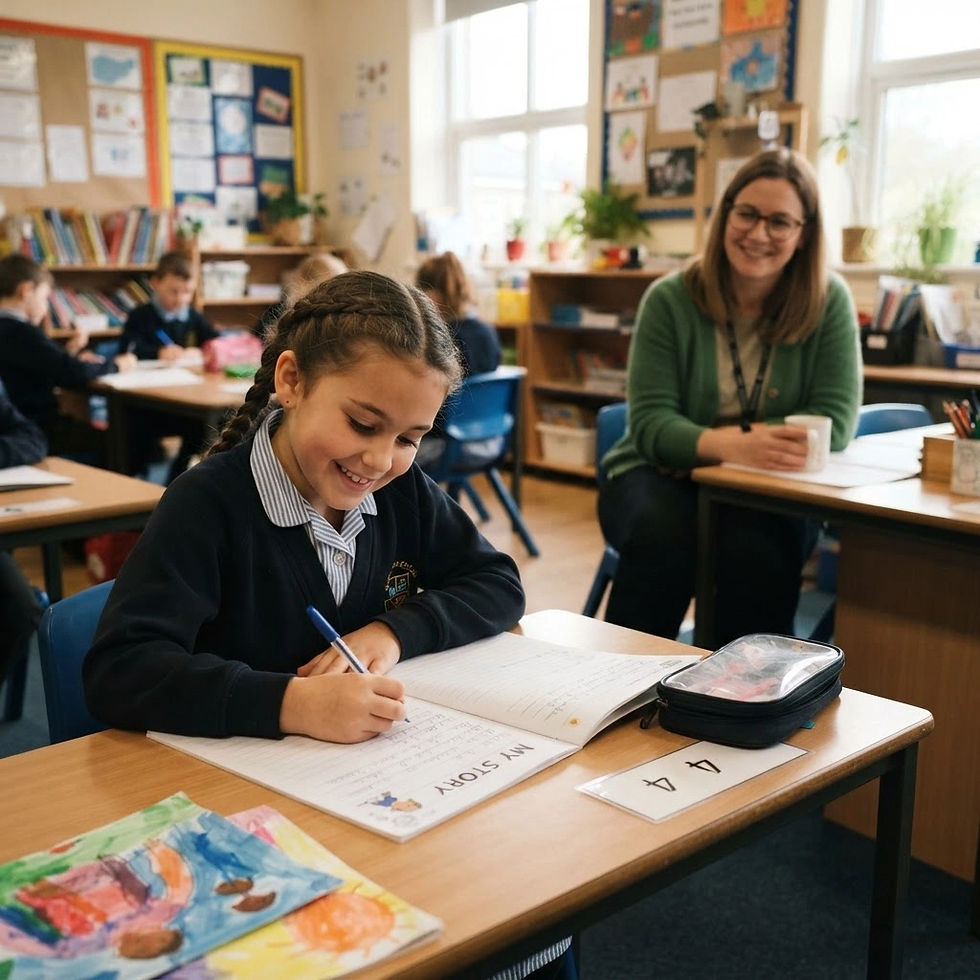
This is where it helps to separate motivation from skill. If your child can complete a task independently in one situation but cannot manage a similar task in another, the difference may be the demands placed on their attention, memory, planning, or emotional regulation.
Our educational therapists and speech and language therapists look at these underlying skills alongside the child's learning profile and everyday functioning. For parents, this can be an important shift. Instead of asking, “Why won't my child do it?”, you can begin asking, “What part of doing it independently is still difficult?”
Did I cause my child to depend on me?
If you have been thinking, “Maybe I helped too much,” take a breath. Supporting your child does not mean you have caused their difficulties. Parents naturally step in when a child is stuck. You remind them, explain again, organise their things, finish the difficult part, or sit beside them because you want them to succeed. The goal is not to suddenly remove all support.
The goal is to understand which support your child needs now, and which support can gradually be reduced. For one child, that might mean using a visual checklist. For another, it might mean breaking a large assignment into smaller steps. Another child may need help developing strategies for working memory, planning, attention, or emotional regulation.
Independence is usually built gradually.
A useful approach is to move from:
“I’ll do it with you.”
to
“Let’s work out the first step together.”
to
“Tell me what your first step is.”
and eventually:
“Show me how you would start.”
That gradual release gives your child a chance to experience success without making them feel suddenly unsupported.
What can I do this week if my child always needs me?
Choose one familiar routine, not everything at once. It could be packing the school bag, starting homework, getting dressed, or preparing for bedtime. Write down the steps in simple language. Then notice exactly where your child gets stuck. Instead of immediately answering, pause and ask:
“What is the first thing you need to do?”
If they still cannot begin, give the smallest prompt that helps them move forward. Over time, reduce that prompt. You are not trying to prove that your child can manage alone. You are helping them build the skills and confidence to eventually say, “I know what to do next.”
If the same difficulty continues across settings, speaking with a professional can give you a clearer picture of whether your child would benefit from targeted support. Educational Therapy can be particularly useful when learning difficulties are connected with executive functioning, attention, organisation, or independent task completion.
If you would like to understand whether your child's challenges may be affecting communication and learning together, you can also explore our content on speech delay in Singapore, executive function skills for children, and early intervention for children.
If you are unsure where to begin, start with one observation this week: identify the exact moment your child needs you, rather than simply noticing that they need you. That small distinction can tell you a lot.
At Total Communication, we understand how difficult it can feel when your child seems capable but still needs you beside them. You do not have to work out the reason alone. A conversation can be the first step toward understanding what support would make independence easier.
Book a consultation with Total Communication today.
Total Communication Phone: +65 9115 8895
WhatsApp: +65 9115 8895
Website: www.totalcommunication.com.sg
Address: 1 Pemimpin Drive #11-08, Singapore 576151
Frequently Asked Questions
Why does my child understand instructions but still need help?
Understanding an instruction is only one part of completing a task. Your child may still need support with attention, working memory, planning, sequencing, or getting started. Contact Now: +65 9115 8895
How can I teach my child to become more independent?
Start with one familiar routine and break it into clear steps. Give the smallest prompt needed, then gradually reduce your help as your child becomes more confident. Contact Now: +65 9115 8895
At what age should my child be doing things independently?
There is no single age at which every child should manage every task independently. Expectations should reflect the child's age, developmental profile, learning demands, and progress over time. Contact Now: +65 9115 8895
Should I contact Total Communication if my child always needs me?
Yes, particularly if the pattern is affecting schoolwork, routines, confidence, or family life. Contact Total Communication to discuss your concerns and explore whether an assessment or targeted support could help. Contact Now: +65 9115 8895


Comments