

What Are the 4 Attachment Styles in Children, and What Do They Mean for the Future?

Key Takeaways
Attachment describes how a child learns to seek comfort, safety and connection from the people who care for them.
There are four recognised styles: secure, anxious, avoidant and disorganised.
Attachment styles are patterns shaped by everyday experience, and they can shift over time.
Avoidant attachment is the easiest to miss, because a child who seems independent and undemanding can look as though all is well.
Early attachment influences emotional regulation, friendships, help-seeking and, later, adult relationships.
Warm, predictable, responsive caregiving supports secure attachment at any age. Good enough is what counts, and perfect is not required.
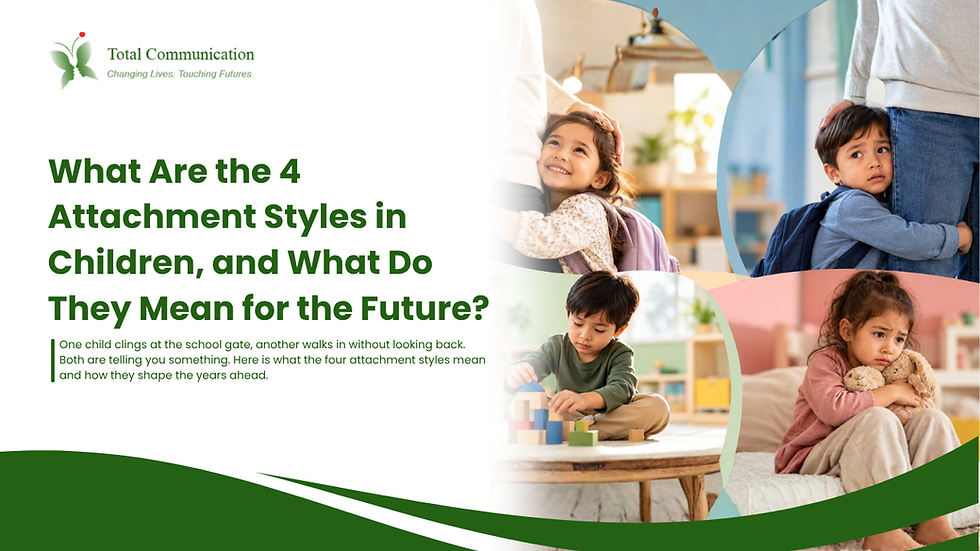
At the preschool gate, your three-year-old grips your leg while the other children wave and walk in. Another parent's child heads inside without a backward glance, and you find yourself wondering which of the two should worry you more. Later, at 2am, the thought arrives: did I do something to make my child this way?
What Is Attachment Style in Children?
Attachment style is the pattern a child develops for seeking comfort and trusting others, based on how their caregivers have responded to their needs. The idea comes from psychologist John Bowlby, and Mary Ainsworth's research later identified distinct patterns. A fourth, disorganised, was added by Mary Main and Judith Solomon in the 1980s. Attachment grows from thousands of ordinary moments: a cry that is answered, a hug after a fall, a goodbye followed by a reliable return. No parent gets every moment right, and research suggests that being responsive most of the time is enough.
What Are the Four Attachment Styles?
What Does Secure Attachment Look Like?
A securely attached child may protest at a goodbye, then settle, and greet you warmly on return. They use you as a safe base, exploring the world and coming back for comfort when needed. In large community studies, roughly 6 in 10 children show this pattern (van IJzendoorn and colleagues, 1999).
Looking ahead: Secure children tend to find it easier to ask for help, manage big feelings, build friendships and recover from setbacks. This often carries into trusting, balanced adult relationships.
What Does Anxious Attachment Look Like?
Anxious attachment (also called ambivalent or resistant) often looks like intense distress at separation and difficulty being soothed afterwards. The child may cling, then push away, because they are unsure whether comfort will arrive. It usually grows where care has felt unpredictable, warm one moment and unavailable the next.
Looking ahead: These children may seek frequent reassurance, worry about friendships and feel unsettled by change. In adulthood, this can appear as a strong fear of being left or a need for constant closeness.
What Does Avoidant Attachment Look Like?
An avoidant child often appears unusually independent. They may barely react when you leave, play on without looking up when you return and rarely seek comfort when hurt. Teachers may describe them as easy, self-sufficient or mature for their age, which is exactly why this pattern so often goes unnoticed.
Underneath, many of these children are managing feelings alone. Having learned that showing a need does not always bring a response, they stop showing it. Research on stress responses suggests that a calm outside does not always mean a calm inside. In the same large studies, around 15 in 100 children show this pattern.
Why Is Avoidant Attachment So Easy to Miss?
Because it is quiet. An anxious child announces their needs loudly, while an avoidant child tucks them away. Parents often hear praise ("such a good, independent boy") for the very behaviour that deserves a closer look.
Signs worth noticing at home and school:
Rarely asks for help, even when stuck or upset
Prefers to play or work alone, and steps back from comfort
Finds it hard to name or describe feelings
Appears unbothered by separation or reunion
Shows distress through stomach aches, withdrawal or sudden outbursts rather than words
How Does Avoidant Attachment Show Up Later in Life?
Self-reliance can be a real strength. The difficulty comes when independence becomes the only option. Avoidant children may find it harder to ask for help, express emotional needs or feel comfortable with closeness. In the teenage years, this can look like keeping parents and friends at arm's length. In adulthood, it often appears as discomfort with intimacy and a habit of handling everything alone.
What Does Disorganised Attachment Look Like?
Disorganised attachment shows as mixed or confused behaviour around a caregiver. A child may move towards you, then freeze, or look for comfort while seeming afraid. It is most often linked to early experiences of fear, loss or chaos, and it is the pattern where professional support helps most.
Looking ahead: Without support, these children may find emotional regulation difficult and relationships both wanted and frightening. With consistent, safe relationships, many children move towards greater security.
What Helps an Avoidant Child Feel Safe to Reach Out?
The goal is to make asking for comfort feel safe and rewarding. Small, steady habits work best:
Name feelings gently. "That looked frustrating" gives a child words they may not yet have.
Stay close during big feelings. Sitting nearby, calm and available, shows that emotions can be shared.
Respond warmly to small bids. When your child does ask for help, however briefly, meet it with welcome.
Create low-pressure connection. Side-by-side activities such as drawing, walking or building often open more conversation than face-to-face talks.
Model feelings yourself. "I felt a bit tired and cross today, so I took a break" shows that needs are normal.
What Gets in the Way of Secure Attachment?
Most parents are doing their best in demanding conditions, so this is a gentle checklist rather than a judgement. These patterns tend to hold connection back:
Praising independence above all else, which can teach a child that needing you is a weakness
Hurrying a child out of big feelings with "you're fine" or "stop crying"
Responding warmly some days and unpredictably on others, often because of stress or exhaustion
Comparing siblings or classmates ("why can't you be more like...")
Repeated long separations without preparation or a clear sense of when you will return
The encouraging part is that each of these can be replaced. A calm "I am here" sentence, repeated often, does more than most parents expect.
Can an Attachment Style Change?
Yes. Attachment patterns show moderate stability, and they respond to new experiences. A steady teacher, a patient grandparent, a changed home routine or professional guidance can all help a child build what researchers call earned security. The earlier the support, the easier the shift, though change is possible at every age.
How Do Attachment Styles Connect to Communication?
Attachment is learned through communication. A child who finds their signals understood learns that speaking up works. A child whose signals go unanswered may learn to escalate, or to go quiet. This is why attachment shapes emotional expression, social-emotional development and the confidence to ask for what they need.
At Total Communication, we view every child through a neurodiversity-affirming lens. A neurodivergent child may express closeness differently, such as bringing you a favourite object instead of reaching for a hug, and these signals deserve to be read accurately.
When Should I Seek Support?
Consider a conversation with a child development professional if separation distress is intense and long-lasting, if your child is consistently hard to comfort, if they seem cut off from their feelings, or if you notice sudden changes in behaviour after a difficult event. Seeking clarity early is an act of care, and Total Communication can help you work out which kind of support fits.
What Is One Step I Can Take This Week?
Choose one daily transition, such as the morning goodbye. Keep it brief, warm and the same each day: a phrase, a hug, a promise of when you will return. Predictability tells a child that connection is dependable, and it works for every attachment style.
Understand How Your Child Connects, Communicates and Grows
Every child deserves to feel understood, and every parent deserves clear guidance. Speak with our team to explore how your child expresses needs, handles feelings and builds relationships, and leave with a practical plan for what comes next.
Book a consultation with Total Communication today.
Total Communication Phone: +65 9115 8895 WhatsApp: +65 9115 8895 Website: www.totalcommunication.com.sg Address: 1 Pemimpin Drive #11-08, Singapore 576151
FAQs
Is my child avoidant just because they are independent?
Independence is healthy. The signal to notice is a child who rarely seeks comfort even when hurt or upset, and who struggles to put feelings into words.
Can my child have more than one attachment style?
Children can show different patterns with different caregivers, because attachment forms within each relationship.
Is insecure attachment my fault?
Attachment forms through many factors, including temperament, family circumstances and life events. Responsiveness over time matters far more than any single moment.
At what age do attachment styles form?
The foundations form in the first two years, though patterns continue to develop and change through childhood.
Important links:


Comments