

How Can Pretend Play Build Language in a Program for Kids in Singapore?


“Why does my child talk so much during play, but become so quiet when I ask questions?”
You may have heard yourself wondering this after watching another child confidently pretend to run a shop, cook a meal, or care for a toy animal. It can bring comparison anxiety, guilt, or the fear that you should have started doing more sooner. The good news is that play itself can become part of the support. A program for kids in Singapore that uses pretend play can give children natural opportunities to practise vocabulary, sentences, questions, instructions, problem-solving, and social communication.
Why does pretend play help children learn language?
Pretend play gives children a reason to communicate. Instead of practising language as isolated words or worksheets, children use language because something is happening in the play. They may need to ask for an item, describe what they see, explain what happened, answer a question, or decide what should happen next. This is the thinking behind Total Communication's approach. The programme is designed for children aged 4 to 7 who are developing emerging language skills, using storytelling, role-play, hands-on activities, and structured pretend-play scenarios. Our therapists use play as a meaningful context for communication, while also creating opportunities to strengthen thinking and social skills.
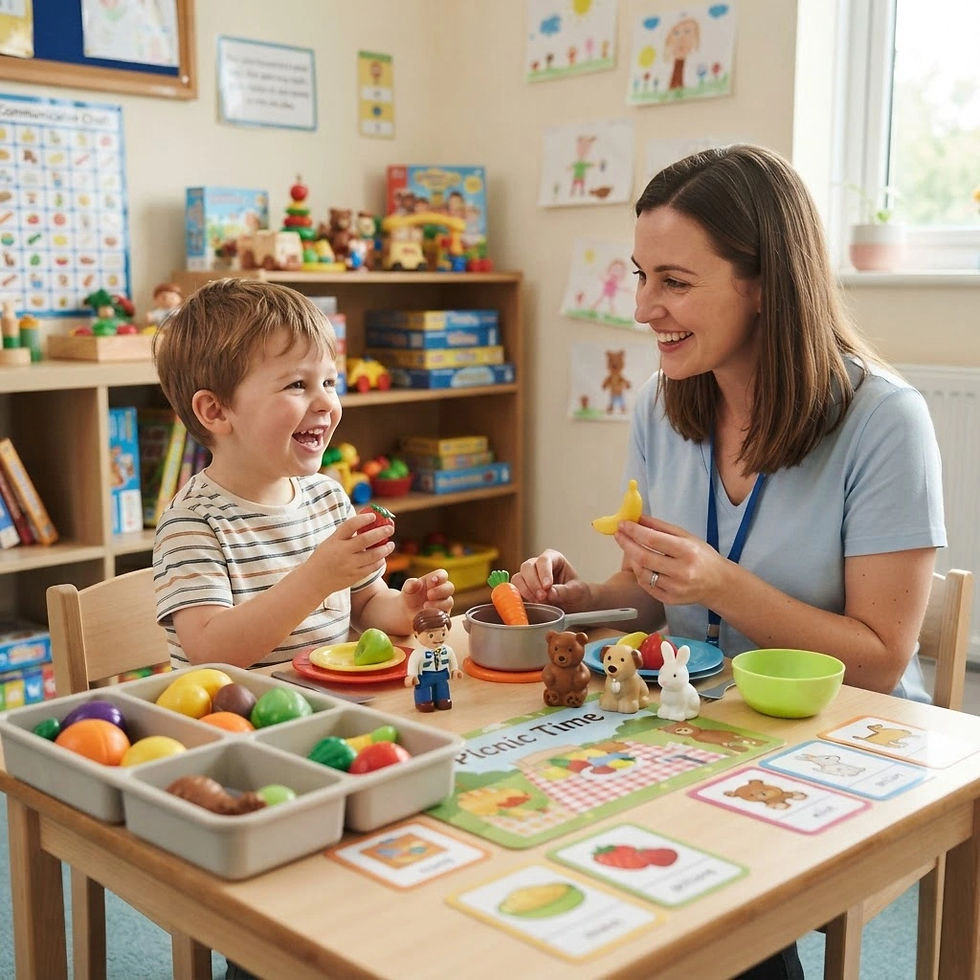
Play can support areas such as:
Vocabulary for emotions, actions, descriptions, and categories
WH-questions such as who, what, where, and why
Sentence building through modelling and visual support
Transition and connector words
Following multi-step instructions
Imagination and symbolic play
Emotional recognition and expression
Flexible thinking and problem-solving
Joint attention and turn-taking
Early inferencing skills
What does language stimulation look like during pretend play?
Imagine a supermarket pretend-play session. A child might begin by sorting food into groups. Then they may be encouraged to request an item, describe its colour or size, answer “where” questions, or explain what they want to buy. One simple activity can therefore create several language opportunities. The programme described by Total Communication uses four pretend-play themes:
Supermarket Adventures focuses on categorisation, requesting, and describing items.
Restaurant and Kitchen Play introduces sequencing, action words, and turn-taking dialogue.
Zoo and Vet Clinic creates opportunities for WH-questions and problem-solving within play scenarios.
Community Helpers supports vocabulary groups, simple sentences, and following directions.
The important part is that the child is communicating for a purpose. They are not simply repeating a word because an adult asked them to. For parents who are trying to understand broader communication concerns, our guide to speech delay in Singapore can also help you recognise patterns that may be worth discussing with a professional.
What language skills can my child practise through play?
Pretend play can be especially useful because one scenario can be adapted to the child's communication level. A child who is using single words may practise naming and requesting.
A child who is combining words may work on simple sentences such as “I want the red apple” or “The dog is sick.”
A child who is already speaking in longer sentences may practise sequencing, explaining, answering why questions, or solving a problem within the story. The adult can model language without taking over the play.
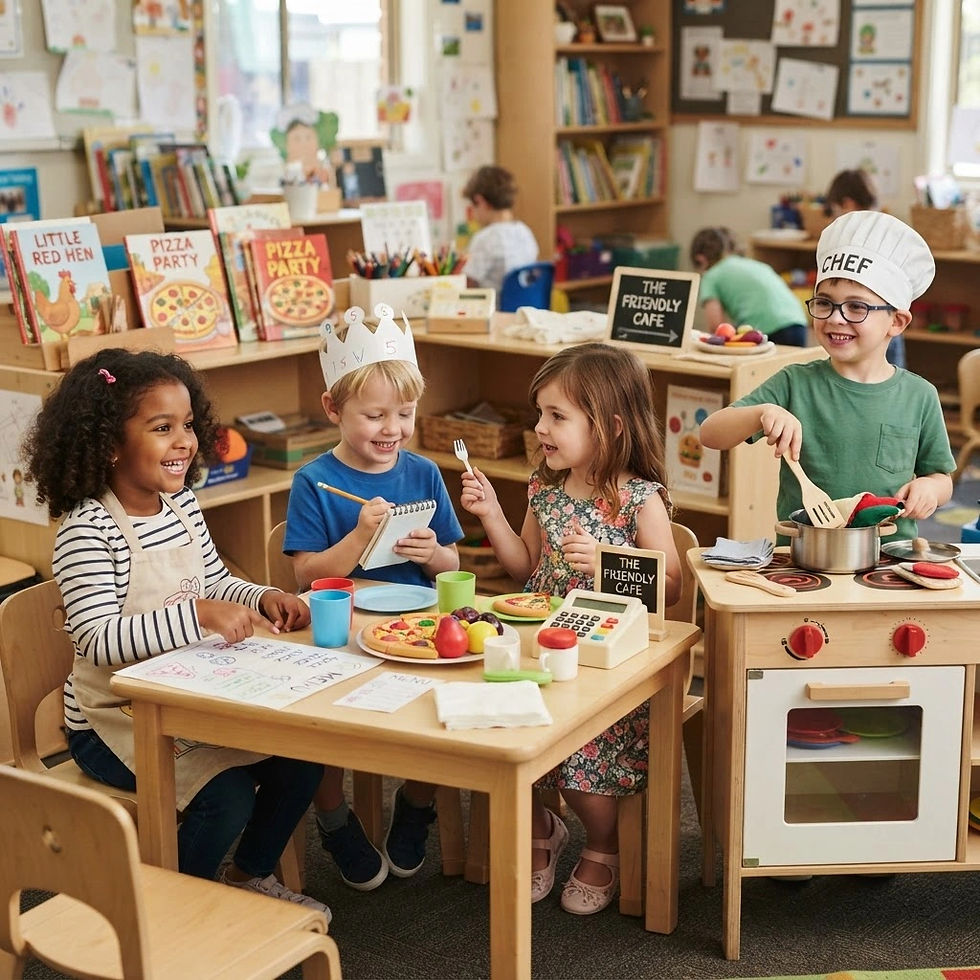
For example:
Child: “Dog sick.”
Adult: “Yes, the dog is sick. We need to help the dog.”
Child: “Doctor.”
Adult: “Yes, let's call the doctor. What should the doctor do?”
The goal is not to make every interaction feel like a lesson. It is to create enough meaningful opportunities for the child to hear, understand, and use language.
Is pretend play useful for thinking and social communication too?
Yes. The programme is designed around both language and cognition. Children practise sharing attention with another person, waiting for a turn, recognising emotions, adapting when the pretend story changes, and working out what to do next. These skills matter because communication is more than knowing words. A child also needs to understand what another person is saying, organise their own ideas, respond appropriately, and participate in shared activities.
The programme's structure reflects this broader goal. Sessions include interactive storytelling, a pretend-play scenario, a hands-on craft or game, and reflection with ideas that families can carry into home routines. This kind of carryover matters. A child does not need to reserve communication practice for a therapy room. A kitchen, supermarket trip, bath-time routine, or toy animal can become an opportunity for meaningful interaction. If you are exploring different types of support, our guide to speech therapy for parents explains how speech and language support can address communication beyond pronunciation alone.
Could my child actually benefit from a structured play programme?
The programme in the source material is specifically designed for children aged 4 to 7 who are developing emerging language and communication skills. It runs for four weeks, with two sessions each week and two hours per session. The small-group format is designed to encourage active participation, while the structured themes give children repeated opportunities to communicate, collaborate, and express ideas.
That does not mean every child needs the same type or amount of support. What matters is understanding your child's current communication profile and choosing activities that match their needs. And if part of your worry is, “Did I cause this?” or “Have I waited too long?”, try to step away from blame. Language development is complex, and a parent does not need to create perfect learning opportunities every day. What you can do is create more moments where your child has a reason to communicate, play, think, and connect.
The programme's intended gains include greater confidence in communication, stronger thinking and social skills, better expression of needs and ideas, and structured learning through play. This week, choose one pretend-play theme your child already enjoys. Set aside 15 minutes, follow their lead, and add simple language to what they are doing. If they are playing restaurant, you might ask what they are cooking, describe the food, take turns ordering, and talk about what happens next.
Small moments like these can give your child's language somewhere meaningful to grow.
At Total Communication, we believe play can be a powerful setting for children to practise communication, thinking, and social interaction in ways that feel natural and enjoyable. If you would like to understand whether structured language support could suit your child, we are here to talk through the next step with you.
Call us: +65 9115 8895 WhatsApp us: https://wa.me/6591158895 Visit us: totalcommunication.com.sg
Frequently Asked Questions
“What age is pretend play language stimulation suitable for?”
The Total Communication programme described here is designed for children aged 4 to 7 who are developing emerging language and communication skills. The activities can be adapted according to a child's individual communication level.
“How can I use pretend play at home to help my child talk?”
Choose a familiar theme such as a supermarket, restaurant, zoo, or doctor's clinic. Follow your child's play, model useful words and sentences, and give them opportunities to request, describe, answer questions, and take turns.
“Can pretend play help my child follow instructions?”
Yes. Pretend-play activities can include simple directions and gradually build towards multi-step instructions. Everyday scenarios make these instructions meaningful because the child can immediately use them within the activity.
“Does my child need speech therapy if they can communicate during play?”
Being able to communicate during play is useful information, but it is only one part of a child's overall communication profile. If you have ongoing concerns about language, understanding, sentences, or social communication, a speech and language therapist can help you understand what support may be appropriate.
Important links:


Comments