

Why Do So Many Bright Singapore Children Struggle to Tell Their Own Story?

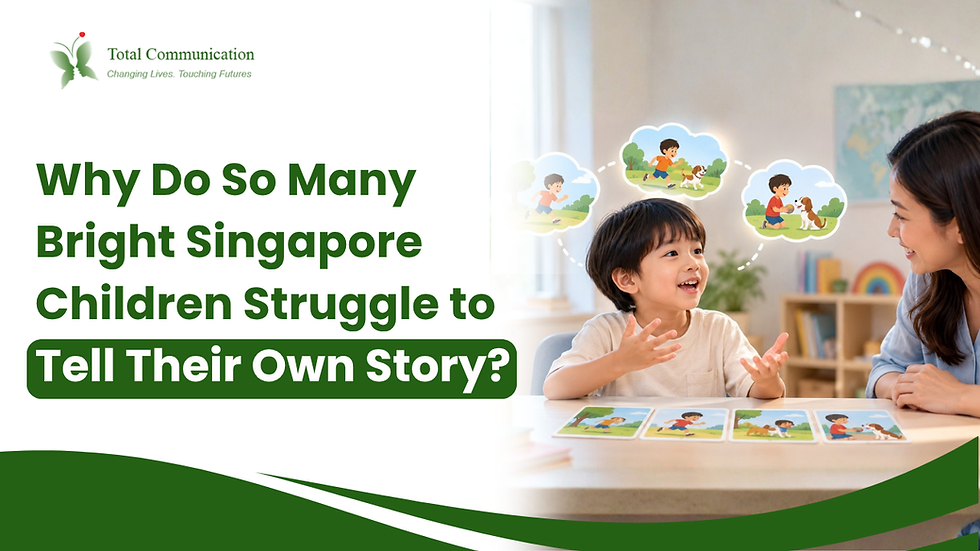
A child comes home from school and you ask the simplest question a parent can ask. How was your day. The answer is one word, or a shrug, or "I don't know," even though you know something clearly happened. This is one of the most common and most overlooked patterns among Singapore children today, and it rarely has anything to do with how much a child knows or how bright they are. The direct answer is this. Many children who seem hesitant, vague, or disorganised when speaking or writing are not struggling with ideas. They are struggling with narrative language, the specific skill of organising thoughts into a clear beginning, middle, and end. This is exactly the gap that Braidy The Storybraid, a structured programme by Total Communication, is designed to close.
What Is Actually Happening When a Child Cannot Organise Their Thoughts?
Narrative language is not the same as vocabulary or intelligence. It is the underlying skill that lets a child take a jumble of ideas and events and turn them into something a listener or reader can actually follow. A child can know exactly what happened during recess, understand every detail perfectly, and still be unable to tell you about it in an order that makes sense. This is not a confidence issue or a laziness issue. It is a specific, teachable skill, and when it is underdeveloped, it quietly affects far more than conversation at the dinner table. It shapes how a child writes compositions, how they answer comprehension questions, and how confidently they speak up in class.
This is why narrative language is often described as a foundation. Reading comprehension depends on being able to follow a story's structure. Written expression depends on being able to plan an idea before putting it on paper. Confident spoken communication depends on being able to organise a thought quickly enough to say it out loud. When the foundation is shaky, everything built on top of it feels harder than it should.
What Signs Do Parents Usually Notice First?
Most parents notice something before they can name what it is. The signs tend to show up in small, repeated moments rather than one dramatic incident, which is exactly why they are so easy to dismiss as a phase.
Why Do Short or Incomplete Answers Matter More Than They Seem?
When a child consistently answers questions about their day with one word or a vague gesture toward "nothing much," it is tempting to read this as shyness or a mood. Often, it is something more specific. The child may genuinely be unsure how to begin organising everything that happened into a sentence, so the shortest possible answer becomes the easiest way out.
Why Does Retelling a Story Out of Order Matter?
A child who jumps around when recounting a story, starting in the middle, backtracking to explain something they forgot, or leaving out the ending entirely, is showing you their internal story structure directly. This is one of the clearest and most consistent early indicators of a narrative language gap, and it usually shows up in speech well before it becomes obvious in writing.
Why Does Difficulty Explaining "Why" or "How" Matter?
Explaining what happened is one skill. Explaining why it happened, or how one event led to another, requires a further layer of reasoning called cause and effect thinking. A child who can describe events but cannot connect them, "the boy fell down" but not "the boy fell down because he was running too fast," is often working harder than their peers just to keep up with classroom discussions built around this kind of reasoning.
Why Does Struggling to Organise Writing Matter?
Difficulty getting ideas onto paper is frequently misread as a handwriting problem or a motivation problem. In many cases, the real barrier is upstream of the pencil entirely. If a child cannot yet organise an idea into a sequence in their head, no amount of encouragement to "just start writing" will make the blank page easier to face.
Why Does Quietness During Class Discussions Matter?
A child who seems hesitant or withdrawn during class discussions is sometimes assumed to be simply reserved by nature. For some children, this is accurate. For others, the hesitation is narrower and more specific. They may have a relevant thought but feel unsure how to structure it quickly enough to contribute before the conversation moves on, so silence becomes the safer option.
What Are Parents Often Told to Look For, Compared to What They Should Actually Look For?
Parents are frequently told to watch for vocabulary size or reading level as the main markers of a child's language development. These matter, but they are not the full picture, and focusing on them alone can mean a narrative language gap goes unnoticed for years, since a child can have a strong vocabulary and still struggle deeply with structuring and sequencing ideas.
What actually matters more is consistency across contexts. A single vague answer about one bad day means very little. A repeated pattern, across spoken retellings, written work, and classroom participation, over weeks or months, is what points toward something worth addressing directly rather than waiting out.
What Is Braidy The Storybraid, and How Does It Address This?
Braidy The Storybraid is a structured programme developed by Total Communication specifically to build narrative language skills in children who show these patterns. Rather than treating storytelling as an abstract creative exercise, the programme breaks it down into a concrete, repeatable framework that children can apply to their own experiences, their schoolwork, and their everyday conversations.
How Does the Programme Actually Work, Step by Step?
The programme moves through four connected stages, each building directly on the one before it.
What Happens in the Visual Story Framework Stage?
Children are introduced to a consistent visual structure for organising a story, giving them a concrete way to picture beginning, middle, and end before they are asked to produce any of it independently. This visual anchor is what makes the rest of the programme accessible, since it gives children something tangible to return to whenever a story starts to feel overwhelming.
How Does This Differ From a Typical Classroom Storytelling Exercise?
A classroom exercise usually asks a child to tell a story without first teaching them a reliable structure to hang it on. Braidy The Storybraid reverses this order, teaching the structure first so the story itself becomes far less daunting to produce.
What Happens During Guided Storytelling Activities?
Once the framework is in place, children practise applying it through guided, multi-sensory activities designed to feel engaging rather than clinical. This stage is where the framework moves from something a child recognises to something a child can actually use on their own.
How Does Speech and Written Practice Build on This?
The same structure is then carried into both spoken and written practice, so the skill transfers directly into schoolwork rather than staying confined to therapy sessions. This is a deliberate design choice, since the ultimate goal is classroom and everyday impact, not just improvement within a session.
What Does the Confidence and Independence Stage Look Like?
In the final stage, children are supported in using the framework independently, without needing an adult to prompt each step. This is the point at which families typically start to notice the shift carrying over into daily life, in conversations at home, in written homework, and in classroom participation.
Why Does Independence Matter More Than Short-Term Improvement?
A child who can only structure a story with heavy adult support has not yet built a durable skill. The programme is specifically designed around the final handoff to independence, because that is what determines whether the improvement holds once formal sessions end.
Who Is This Programme For, and When Should a Family Start?
Braidy The Storybraid is designed for children who show a consistent pattern of difficulty organising spoken or written narratives, regardless of whether their vocabulary or overall language ability seems otherwise typical for their age. This includes children who give short or incomplete answers about their day, struggle to retell events in order, find it difficult to explain why or how something happened, or seem quiet during classroom discussions despite having relevant ideas.
The right time to start is not after a school report flags a persistent issue. Narrative language is foundational to reading comprehension and written expression, both of which compound over years of schooling, so earlier support tends to prevent smaller gaps from becoming larger academic struggles later. If these patterns have been consistent for more than a few weeks, that is sufficient reason to have a conversation with the team rather than waiting for the next report card.

Where and How Are Sessions Conducted?
Sessions are available both centre-based and over Zoom, by appointment only, giving families the flexibility to choose whichever format fits their schedule and their child's comfort level. Each session is tailored to the individual child's developmental needs rather than delivered as a fixed, one-size-fits-all curriculum.
What Results Can Parents Expect?
Families working through the programme typically see improvement across four connected areas. Written compositions become more structured and complete. Classroom participation becomes stronger and more confident. Self-expression improves noticeably, both in what a child says and how readily they say it. Reading comprehension and inference skills sharpen, since the same sequencing and cause-and-effect thinking that supports storytelling also supports understanding what a child reads.
What Is the Key Takeaway for Parents Right Now?
If your child consistently gives short answers, struggles to retell events in order, or seems hesitant during discussions despite clearly having something to say, the most useful next step is not more encouragement to speak up. It is a structured framework that gives them a reliable way to organise their thoughts. Braidy The Storybraid was built specifically for this gap, and the earlier it is addressed, the more naturally these skills carry into schoolwork and everyday confidence.
How Can I Book a Session for My Child With Total Communication?
Spaces for Braidy The Storybraid are limited, since each session is tailored individually rather than run as a large group class. If the patterns described above sound familiar, the most direct next step is to download the full programme brochure now and reach out to the Total Communication team the same day to check current availability for centre-based or Zoom sessions.
Call or WhatsApp the team directly at +65 9115 8895, or email enquiries@totalcommunication.com.sg to book an appointment for your child this week. The sooner a session is scheduled, the sooner your child begins building the narrative language skills that support everything from written compositions to classroom confidence.
Website: www.totalcommunication.com.sg
Frequently Asked Questions
What is narrative language, and why does it matter?
Narrative language is the ability to organise thoughts and events into a clear beginning, middle, and end. It underlies reading comprehension, written expression, and confident spoken communication, which is why a gap in this skill can affect a child's performance across multiple areas of school.
How do I know if my child needs support with storytelling skills, or if this is just a phase?
A single vague answer about one day is normal. A consistent pattern across weeks or months, in spoken retellings, written work, and classroom participation, is what distinguishes a genuine gap from a passing phase.
Is Braidy The Storybraid only for children who are behind academically?
No. The programme is designed for any child showing consistent difficulty organising spoken or written narratives, even when their vocabulary and overall language ability otherwise seem typical for their age.
Are sessions available online, or only in person?
Both. Total Communication offers centre-based and Zoom sessions by appointment, so families can choose the format that works best for their schedule.
How soon should I book a session if I recognise these signs in my child?
As soon as the pattern has been consistent for a few weeks. Since narrative language supports skills that compound over years of schooling, earlier support tends to prevent smaller gaps from becoming larger academic challenges later.
Important links:


Comments