

What Is Changing in Speech and Developmental Support in Singapore? (October 2026 Update)


Key Takeaways
The Taskforce on Assurance for Families with Persons with Disabilities released its report on 4 October 2026, with measures rolling out by 2030. From 2027, all polyclinics will be equipped to support patients with disabilities, including pre-visit preparation. Average early intervention waiting time fell from 7.5 months in 2023 to 5.5 months in 2025, the latest official figure available. Singapore is also training more speech and language therapists through annual university intakes. You are in a polyclinic waiting area with a child who has covered both ears, and the number being called is lost in the noise. Later, at 2 am, a quieter thought arrives: is anything actually getting easier for families like ours?
Is Support for Children With Developmental Needs Improving in Singapore?
Yes, and some of it is very recent. On 4 October 2026, the Ministry of Social and Family Development (MSF) released the taskforce report on support for families with persons with disabilities. From 2027, every polyclinic will be equipped to support patients with disabilities. Early intervention waits have shortened, and more therapists are being trained. Each change is explained below, with its source and date.
What Did the 4 October 2026 Taskforce Report Say?
Prime Minister Lawrence Wong announced the taskforce on 5 December 2025, and MSF said it would study employment, community living and affordability (MSF, 5 December 2025). The report followed in early October. Media coverage describes a 67-page document built on engagements with more than 200 people, including caregivers and service providers, with measures to be implemented by 2030 (Memesita, 4 October 2026; AsiaOne, 4 October 2026; People Matters, 5 October 2026). Little Big Red Dot reports that the Government will spend up to an additional 60 per cent on average per person with disabilities over the next five years, organised around three shifts: planning ahead rather than reacting, steadier employment and fuller community life (5 October 2026; see also People Matters, 5 October 2026, and MSF, 4 October 2026). The report covers every life stage, so some measures apply more to adults than to young children. Families can read the full report on the MSF website to see which recommendations match their child's age (MSF, 4 October 2026).
What Will Change for Clinic and Healthcare Visits?
Minister of State Rahayu Mahzam said at the 2 October 2026 press conference that, from 2027, all polyclinics will be equipped to support people with disabilities as they access services, including pre-visit preparation. She added that the Government will look at longer-term healthcare support and costs (Ministry of Health, 2 October 2026; AsiaOne, 4 October 2026). For a child who finds waiting rooms overwhelming, preparation before the visit can make an appointment far more manageable.
How Long Is the Wait for Early Intervention Now?
The Early Intervention Programme for Infants and Children (EIPIC) supports children under 7 with developmental needs (Early Childhood Development Agency [ECDA], n.d.). In a parliamentary reply, MSF stated that average waiting time improved from 7.5 months in 2023 to 5.5 months in 2025, and that places grew by around 25 per cent, from about 5,800 to 7,300. EIPIC operators also support families from the point of referral, and the Step One programme, run with CaringSG through SG Enable, equips caregivers with skills while they wait (MSF, 2025). A 2026 figure had not been published at the time of writing.
Is Singapore Training More Speech and Language Therapists?
Yes. The NUS Master of Science in Speech and Language Pathology moves from a biennial to an annual intake in 2026, to meet demand in eldercare and special education (NUS Libraries, 24 October 2025). The Singapore Institute of Technology offers a four-year honours degree in Speech and Language Therapy, accredited by the Allied Health Professions Council, with its latest intake on 31 August 2026 (SIT, 2026). A larger workforce supports shorter waits over time.
Does the Timing of Support Make a Difference for My Child?
National improvements are welcome, and they will help many families over the coming years. A child’s development, though, moves at the pace of childhood, not policy. The early years are when communication, play and emotional skills are laid down, and each month of the right support builds the base for later learning, friendships and confidence (National Scientific Council on the Developing Child, 2007). This is why many families choose to begin straight away while public measures continue to grow.
At Total Communication, families can start with our team promptly, with a private consultation and a clear plan, without joining a waiting list. Timely, expert support is an investment in your child’s progress, and it can run alongside any referral or subsidised service you pursue.
What Can I Do This Month While These Changes Roll Out?
Write down three specific moments from the past fortnight when your child found it hard to communicate, play or manage a feeling, with the date and what helped. Share that note with your child's preschool or school and with a professional. Specific observations speed up every referral and every assessment, and they cost nothing.
How Does Total Communication Support Families Right Now?
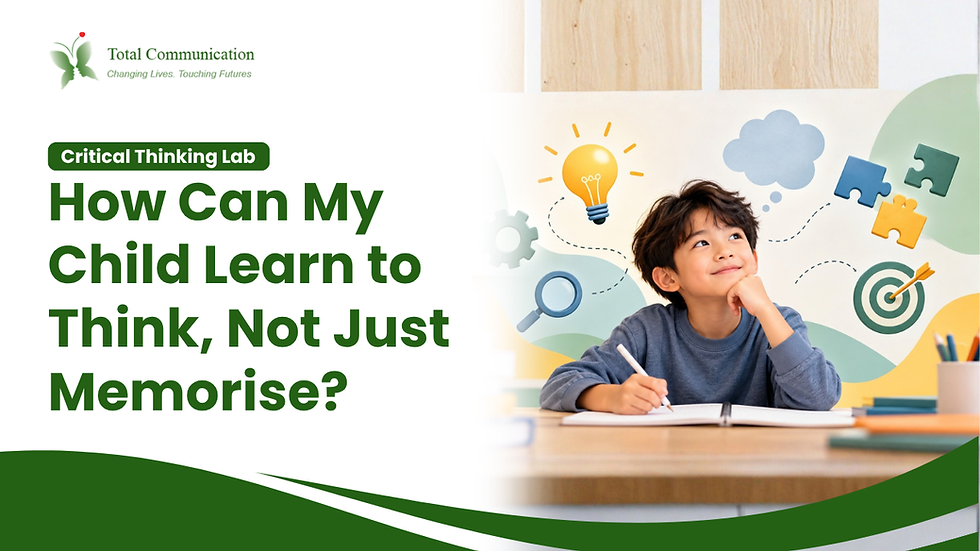
Total Communication works alongside the national system. Our speech and language therapists and wider team support early communication, social and emotional development and learning, from a first assessment to structured thinking programmes such as our Critical Thinking Lab for ages 7 to 13. Our approach is neurodiversity-affirming, so every child is supported to communicate in a way that is confident and their own.
Book a Private Developmental Consultation With Total Communication
Your child deserves clarity without the wait. Meet our team for a focused one-to-one consultation, leave with a clear picture of your child's communication and developmental profile, and receive a personalised plan for the weeks ahead. Places are limited, so reserve yours today.
Connect with Total CommunicationPhone: +65 9115 8895
WhatsApp: +65 9115 8895
Website: www.totalcommunication.com.sg
Address: 1 Pemimpin Drive #11-08, Singapore 576151
FAQs
When will polyclinics begin supporting patients with disabilities?
From 2027, every polyclinic will be equipped to support patients with disabilities as they access care, including pre-visit preparation, according to Minister of State Rahayu Mahzam (Ministry of Health, 2 October 2026).
Who is EIPIC for, and how long is the wait?
EIPIC supports children under 7 with moderate to severe developmental needs, while children with mild needs are supported through preschool-based programmes (ECDA, 2019). The average wait improved from 7.5 months in 2023 to 5.5 months in 2025, the latest official figure, and places grew from about 5,800 to 7,300 (MSF, 2025).
What support is available while we wait for a place?
EIPIC operators support children and families from the point of referral, not only on enrolment. The Step One programme, run by SG Enable with CaringSG, equips caregivers with skills and connects them with other families (MSF, 2025). A private assessment can run alongside, giving every service a clearer picture of your child's strengths and needs.
When will the taskforce recommendations take effect?
The report was released on 4 October 2026, with measures to be implemented by 2030 (Memesita, 4 October 2026; People Matters, 5 October 2026). Some families could see monthly fees after subsidies fall by about 25 to 80 per cent by 2028 (Goody Feed, 5 October 2026). MSF will confirm timelines and eligibility, so its website holds the final detail.
Can my child start with Total Communication straight away?
Total Communication offers private consultations, so your child's profile and a clear plan can be in place without waiting for a public referral. Availability differs by programme, and small groups such as our Critical Thinking Lab are capped at six students, so our team will confirm current openings.
Sources
AsiaOne. (2026, October 4). New employment support office to offer greater job support for persons with disabilities. By Laili Abdeen. https://www.asiaone.com/singapore/employment-support-office-persons-disabilities-msf-mom
Early Childhood Development Agency. (2019, January 28). Enhanced early intervention: Better support for children with developmental needs. https://www.ecda.gov.sg/news/enhanced-early-intervention-better-support-for-children-with-developmental-needs
Early Childhood Development Agency. (n.d.). Early Intervention Programme for Infants and Children (EIPIC). https://www.ecda.gov.sg/parents/other-services/early-intervention-services/early-intervention-programme-for-infants-and-children-%28eipic%29
Goody Feed. (2026, October 5). Some families could see disability care expenses fall by up to 80% by 2028. By George Yang. https://goodyfeed.com/some-families-could-see-disability-care-expenses-fall-by-up-to-80-by-2028/
Little Big Red Dot. (2026, October 5). Disability taskforce report released Sunday commits up to 60 per cent more spending per person. By Clara Tan. https://littlebigreddot.com/disability-taskforce-report-4-october-2026-employment-support-office/
Memesita. (2026, October 4). Singapore unveils major disability support measures by 2030. By Adrian Brooks, News Editor. https://www.memesita.com/singapore-unveils-major-disability-support-measures-by-2030/
Ministry of Health. (2026, October 2). Remarks by Mdm Rahayu Mahzam, Minister of State, at the Taskforce on Assurance for Families with Persons with Disabilities press conference. https://www.moh.gov.sg/newsroom/remarks-by-mdm-rahayu-mahzam--minister-of-state--ministry-of-digital-development-and-information--and-ministry-of-health---at-taskforce-on-assurance-for-families-with-persons-with-disabilities-press-conference--2-october-2026-/
MSF. (2025, December 5). Launch of new taskforce: Assurance for families with persons with disabilities. Ministry of Social and Family Development. https://www.msf.gov.sg/media-room/article/launch-of-new-taskforce---assurance-for-families-with-persons-with-disabilities
MSF. (2025). Changes to average wait time for EIPIC placements and interim support for families awaiting placement [Parliamentary reply]. Ministry of Social and Family Development. https://www.msf.gov.sg/media-room/article/changes-to-average-wait-time-for-eipic-placements-and-interim-support-for-families-awaiting-placement
MSF. (2026, October 4). Taskforce unveils three key shifts to strengthen support for persons with disabilities and their families across life stages [Press release]. Ministry of Social and Family Development. https://www.msf.gov.sg/media-room/article/taskforce-unveils-three-key-shifts-to-strengthen-support-for-persons-with-disabilities-and-their-families-across-life-stages
National Scientific Council on the Developing Child. (2007). The science of early childhood development: Closing the gap between what we know and what we do. Center on the Developing Child, Harvard University. https://developingchild.harvard.edu/wp-content/uploads/2024/10/Science_Early_Childhood_Development.pdf
NUS Libraries. (2025, October 24). Unveiling the journey: Evolution of speech-language therapy in Singapore. By Wong Suei Nee, Elizabeth J. Teh and Wei Ping Sze. https://blog.nus.edu.sg/linus/2025/10/24/unveiling-the-journey-evolution-of-speech-language-therapy-in-singapore/
People Matters. (2026, October 5). Singapore targets 40% employment rate for persons with disabilities by 2030. By Ria Duneja. https://sea.peoplemattersglobal.com/news/diversity-equity-inclusion/singapore-targets-40percent-employment-rate-for-persons-with-disabilities-by-2030-52513
Singapore Institute of Technology. (2026). Speech and Language Therapy, BSc (Hons). https://www.singaporetech.edu.sg/undergraduate-programmes/speech-and-language-therapy

Comments