

Why Does My Child Talk at Home but Struggle With Other Children?

“She's so talkative at home. Why doesn't she say anything when she's with the other children?”
A teacher might say it gently. A relative might say it casually at the playground. But if you are the parent hearing it, you may replay the comment later that night.
You may wonder whether you are overreacting, whether your child is simply shy, or whether you should have noticed something earlier.
The short answer is this: a child can have plenty of language for familiar conversations at home and still find social communication with peers difficult. Talking is only one part of communication. Knowing how to enter play, take turns, respond, understand another child's cues, and keep an interaction going are different skills.
This is an important distinction when thinking about child social communication in Singapore.
Why Can My Child Talk So Much at Home but Struggle With Other Children?
Home is usually predictable. Your child knows who they are talking to, what the conversation is about, and what is expected of them. You may also understand their words, gestures, facial expressions, and unfinished sentences better than anyone else.
A playground or classroom is different.
Your child may suddenly need to:
Walk up to another child and find a way to join their game.
Work out what another child wants without being told directly.
Take turns talking and playing.
Answer questions while also watching what others are doing.
Change the way they communicate depending on the person or situation.
Explain what they mean when another child misunderstands them.
Handle disagreements, losing, waiting, or changing the rules of a game.
These are social communication skills, and they involve much more than vocabulary.
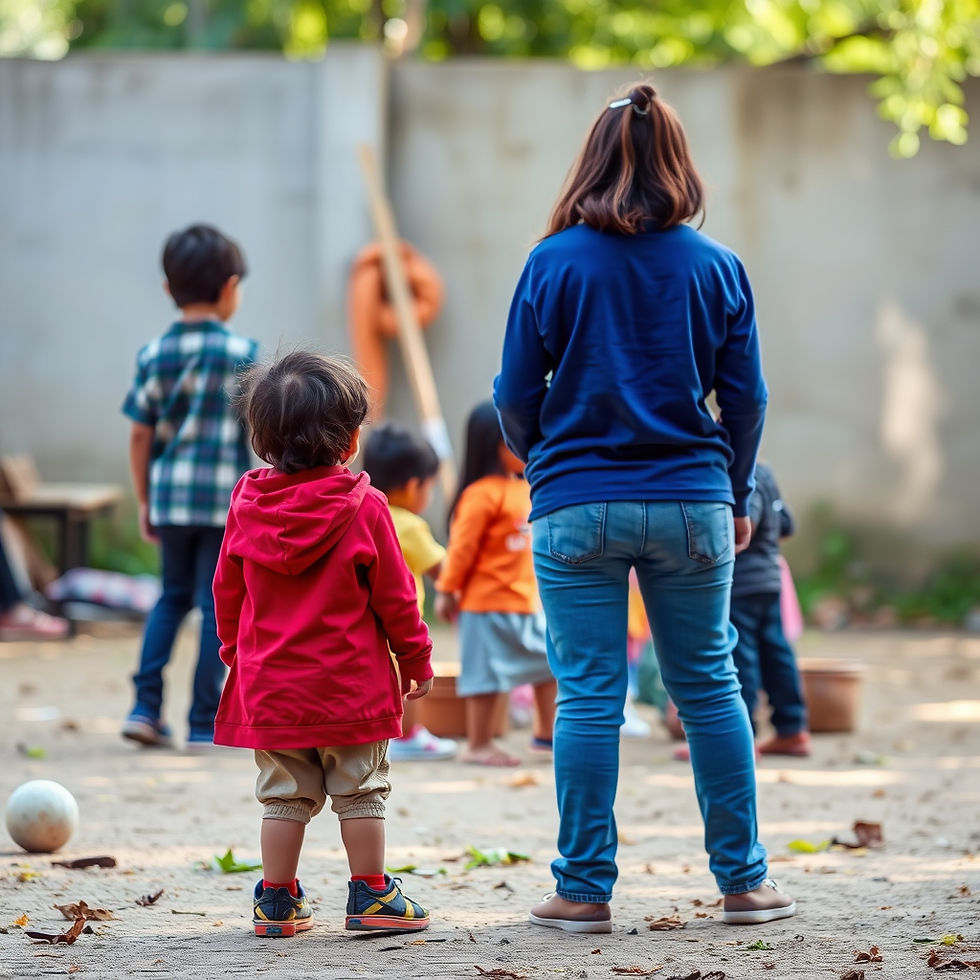
The American Speech-Language-Hearing Association describes social communication as the use of verbal and nonverbal language for social purposes, including conversation, turn-taking, interpreting other people's signals, and forming relationships.
So your child's ability to talk at home is meaningful. It simply does not tell the whole story.
What Signs Suggest My Child May Need Help With Social Communication?
Look at what happens across different situations rather than focusing on one quiet afternoon.
You might notice that your child:
Talks easily with parents but rarely starts conversations with children.
Waits for other children to approach instead of joining their play.
Plays beside children but finds cooperative or imaginative play difficult.
Talks at length about favourite topics without noticing whether the other child is interested.
Finds turn-taking or staying on the same conversational topic difficult.
Does not always understand facial expressions, gestures, tone, or indirect language.
Becomes frustrated when another child does not understand what they mean.
Finds it difficult to explain a problem or repair a communication breakdown.
Knows the words they want to use but cannot work out how to enter a group conversation.
For example, the CDC's 2025 developmental milestones include noticing other children and joining them to play as a social-emotional milestone by age 3. The same milestone guidance includes having at least two back-and-forth conversational exchanges with an adult. These are useful reference points, not a diagnosis, because children develop differently.
Our speech and language therapists look at the whole communication picture, including what a child understands, says, gestures, initiates, responds to, and does during real interactions.
Is My Child Just Shy, or Could Something Else Be Making Social Interaction Hard?
Shyness can absolutely affect how a child behaves around unfamiliar people. Some children need more time to warm up, especially in busy environments.
The more useful question is whether the difficulty is consistent and whether it affects your child's ability to participate.
For example, a child may be quiet for the first ten minutes at a birthday party and then happily join in. Another child may repeatedly want to play but seem unable to work out how to approach the group.
Those situations can look similar from a distance, but the underlying needs may be very different.
Social communication difficulties can involve social interaction, social understanding, pragmatics, or language processing. They can also occur alongside other developmental differences, so a careful assessment matters before drawing conclusions.
If you are also wondering whether your child's language development is progressing as expected, our guide to speech delay in Singapore can help you understand the difference between a temporary variation and a pattern worth discussing.
Did I Cause This, and Can My Child Learn to Communicate More Confidently?
This is often the question underneath the question.
You did not cause your child's social communication difficulties by being too protective, talking to them too much, or not sending them to enough playgroups.
And social communication is not a fixed personality trait.
Children can learn skills such as entering play, taking turns, asking for clarification, reading social cues, and repairing misunderstandings. Therapy can also practise these skills in meaningful situations rather than only at a table with an adult.
ASHA notes that social communication support can include individual teaching alongside group and peer-based practice, helping children use new skills in functional communication settings.

For some children, support may focus on language. For others, it may involve play, social understanding, emotional regulation, conversation, or a combination of these areas.
The goal is not to make your child act like everyone else. It is to give them more ways to connect, participate, express themselves, and feel understood.
If you have been comparing your child's interactions with cousins, classmates, or children at the playground, our guide to language delay intervention may also help you think about what support can look like.
What Can I Do This Week If My Child Struggles With Other Children?
Start by observing, not testing.
This week, choose one natural social situation, such as a playground visit, playdate, childcare drop-off, or family gathering. Watch what happens before, during, and after your child tries to interact.
Write down three things:
What did my child want to do?
What communication did my child use?
Where did the interaction become difficult?
You may discover that your child actually wants to join the game but does not know how to enter. Or perhaps they can enter but struggle to keep the interaction going. Maybe they understand what another child says but cannot respond quickly enough.
That small observation can give you much more useful information than simply asking, “Why doesn't my child play with others?”
If the same pattern keeps appearing, consider discussing it with a speech and language therapist. A professional assessment can help you understand your child's strengths, identify the specific communication skills that are getting in the way, and decide what support would be most useful.
You do not need to have all the answers before asking for help. Sometimes the most helpful first step is simply getting a clearer picture of what your child is already doing well and where they need more support.
An invite to connect
Total Communication Call/WhatsApp: +65 9115 8895
Address: 1 Pemimpin Drive #11-08, Singapore 576151
Opening hours: Tuesday to Saturday, 9 am to 6 pm
Fill out our reach-out form: Contact Total Communication
___________________________________________________________
Important links:
What Questions Do Parents Often Ask About This?
Why does my child talk to adults but not children?
Adults usually provide more predictable conversational cues and may adapt naturally to your child's communication style. Peer interactions require more spontaneous turn-taking, negotiation, flexibility, and social problem-solving.
Can a child have good speech but still have social communication difficulties?
Yes. Clear pronunciation, vocabulary, and sentence structure do not automatically mean that social communication is easy. A child may speak well but struggle with conversation, peer entry, interpreting cues, or cooperative play.
Should I wait and see if my child becomes more social?
It depends on the child's age, development, and how consistently the difficulty appears. If your child wants to connect but repeatedly struggles to participate with peers, an assessment can provide clarity without assuming that something is seriously wrong.
Can speech and language therapy help with making friends?
Therapy can support the communication skills that make peer interaction easier, such as starting conversations, taking turns, understanding social cues, joining play, and repairing misunderstandings. The specific goals depend on the child's individual strengths and needs.

Comments