

Is My Child Having a Tantrum or Trying to Communicate Something?

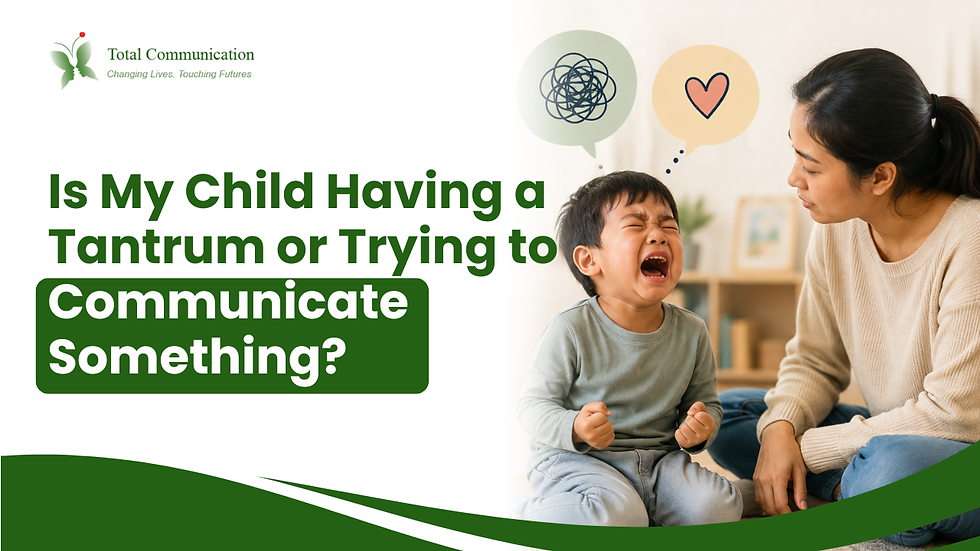
“Why does he always do this when I say no?”
A teacher may mention that your child had another meltdown. A relative may casually say, “He needs to learn how to behave.” Later, you replay the moment in your head and wonder whether you are handling it all wrong.
That mix of guilt, fear of overreacting, and comparison anxiety can be exhausting.
The short answer is that a tantrum can be both a big emotional reaction and a form of communication. Your child may be trying to tell you “I want that,” “I cannot do this,” “I do not understand,” “Help me,” or “This is too much,” even when the message comes out as crying, screaming, hitting, or dropping to the floor. Our therapists look beyond the behaviour itself to understand what may be happening underneath it.
What Is My Child Trying to Tell Me When They Have a Tantrum?
Young children often understand more than they can express. When their communication skills are still developing, frustration can build quickly.

A child might have a meltdown because they:
Cannot find the words to ask for something.
Know what they want but cannot explain it.
Struggle to understand what an adult is asking.
Cannot tell you that something hurts or feels uncomfortable.
Have difficulty waiting, sharing, or changing activities.
Feel overwhelmed by noise, crowds, tiredness, or too many instructions.
Want more independence but do not yet have the language to negotiate.
Have learned that crying or shouting reliably gets a response.
This does not mean every tantrum is caused by a speech or language difficulty. Toddlers also have developing emotional regulation, limited impulse control, and strong preferences.
The useful question is not simply, “How do I stop the tantrum?” It is, “What was my child trying to communicate before the behaviour happened?”
How Can I Tell If Communication Difficulties Are Playing a Role?
Look for patterns rather than judging one difficult moment. Communication may be contributing when your child frequently becomes upset during situations that require them to:
Ask for help.
Answer questions.
Follow instructions.
Explain what happened.
Tell you what they want.
Join play with other children.
Transition from one activity to another.
Express pain, frustration, fear, or disagreement.
Pay attention to what happens immediately before the behaviour. Does your child become upset when you cannot understand their words? Do they point, pull your hand, cry, or physically lead you to what they want? Does the frustration increase when you ask them to explain something? These patterns can provide important clues.
Developmental milestones can also give you a broader picture. For example, the CDC's 2026 milestone guidance says most children can say at least two words together by age 2, use gestures beyond simple waving and pointing, and respond to simple language-based requests. Milestones are useful reference points, but they are not a diagnosis.
For a broader look at communication development, you can also read our guide to speech delay in Singapore.
When Should I Be More Curious About My Child's Communication?
You may want to take a closer look when the tantrums are frequent, intense, difficult to understand, or strongly connected to communication demands. For example, consider whether your child:
Becomes especially distressed when people do not understand them.
Uses very few words or relies heavily on gestures to communicate.
Has difficulty following everyday instructions.
Rarely combines words when you would expect them to.
Seems unable to tell you what they need even when calm.
Becomes frustrated during conversations or questions.
Has lost communication skills they previously had.

Age matters too. The expectations for an 18-month-old are very different from those for a 3-year-old. The CDC's 2026 milestones, for example, include trying to say three or more words besides “mama” or “dada” by 18 months and saying about 50 words and combining words by 30 months. ASHA also emphasises that communication milestones are not diagnostic tools. They are a guide for understanding development and deciding when professional guidance may be helpful. If you are already wondering whether your child's communication is affecting their behaviour, that question itself is worth exploring.
Did I Cause My Child's Tantrums, and Can This Get Better?
This is often the question underneath everything else. Parents can worry that they gave in too much, used screens too much, did not talk enough, or somehow created the behaviour.
A child's communication difficulties are not a simple reflection of parenting. Development is influenced by many factors, and a child's behaviour can change as their ability to understand, express themselves, and regulate emotions develops. There is also something hopeful here: when a child gains more effective ways to communicate, they have more options available to them. Instead of screaming, they may learn to say “help.”
Instead of grabbing, they may point or ask. Instead of collapsing when an activity ends, they may learn to say “more” or “finished.”
That is why speech and language support is not only about producing clearer words. It can also involve helping a child understand language, express needs, communicate socially, and find practical ways to participate in everyday situations. ASHA notes that responding to a child's communication attempts and giving them opportunities to show what they want can support children who have communication difficulties. This is also why our approach looks at the whole communication picture rather than treating a tantrum as simply “bad behaviour.”
This week, choose one recurring tantrum and write down three things: what happened immediately before it, what your child did, and what seemed to calm or help them. Bring those observations to your child's teacher, paediatrician, or speech and language therapist. One clear pattern can be much more useful than trying to remember every difficult moment.
If you have been questioning your child's communication for a while, you can also explore our guide to early intervention and learn more about how speech and language therapy may help. Call us: +65 9115 8895
WhatsApp us: wa.me/+6591158895
Visit us: totalcommunication.com.sg
Frequently Asked Questions
Is every tantrum a sign of a speech delay?
No. Tantrums are a normal part of early childhood, especially while children are developing emotional regulation. Communication difficulties can be one contributing factor, particularly when frustration repeatedly occurs around expressing or understanding language.
How can I help my child communicate during a tantrum?
Keep your language short and calm. Offer simple choices, model useful words such as “help,” “more,” or “finished,” and give your child another way to show you what they need, such as pointing or gesturing.
Should I get a speech assessment if my child has frequent tantrums?
It can be helpful if the tantrums regularly happen when your child is trying to communicate, especially alongside concerns about speech, understanding, gestures, or social communication. An assessment can help clarify whether communication is playing a role and what support may be appropriate.
Can a child have normal speech and still have communication-related tantrums?
Yes. Communication includes much more than vocabulary and pronunciation. A child may have plenty of words but still struggle with understanding language, expressing complex thoughts, social communication, or coping when communication becomes difficult.


Comments