

When "Give Me the Phone Back" Turns Into a Meltdown

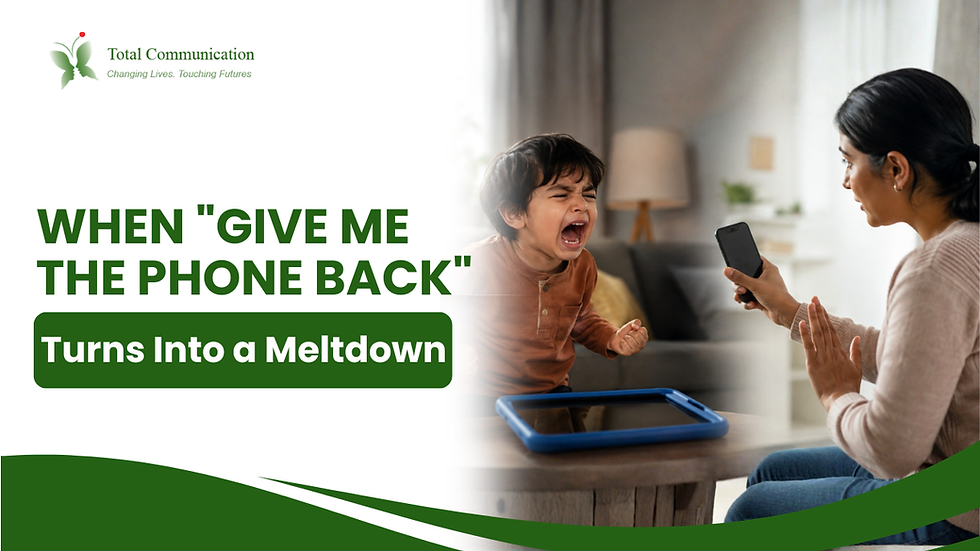
It starts the moment the phone leaves their hands. Not disappointment, something bigger. Shouting. Slammed doors. Sometimes it's aimed at whoever's closest, a grandparent, a parent, the people who love this child most. You've tried firmness. You've tried explaining. Nothing seems to land, and you're left wondering if this is just who your child is now.
The short answer: this reaction is rarely really about the phone. It's usually a sign that a child hasn't yet built the communication and emotional regulation tools to handle frustration, disappointment, or a sudden change, and the phone is simply the trigger that exposes it. That's not a discipline failure on your part. It's a skill gap, and skill gaps can be worked on.
Why Does My Child React So Badly When Screen Time Ends?

For many children, especially those who've had a lot of unstructured screen time, a device becomes their main source of stimulation, comfort, or escape from a task they don't want to do. When it's removed, the brain registers it the same way it would any sudden loss, and if a child doesn't have the words or the coping strategy to say "I'm frustrated" or "I need a minute," that feeling comes out physically instead, through shouting, aggression, or defiance.
This isn't unique to screens. It happens with any transition a child struggles to communicate through. Screens simply make it more visible, because the emotional stakes feel high and the transition happens often, sometimes multiple times a day.
Is This a Behaviour Problem or a Communication Problem?
Often, it's both, but treating it purely as behaviour misses the part that's actually fixable fastest. A child who lashes out instead of saying "I don't want to stop" hasn't necessarily chosen defiance; they may genuinely lack the words, the emotional vocabulary, or the regulation strategy to do anything else in that moment. Punishing the outburst without building the missing skill tends to repeat the same cycle, again and again, because the underlying gap never closes.
What Are the Signs This Goes Beyond Typical Screen Time Battles?
Reacts to losing the phone with aggression, kicking, hitting, or targeted verbal outbursts, not just crying or sulking
Struggles to express frustration in words, even outside of screen time situations
Shows little response to explanation or reasoning in the moment; the reaction feels disconnected from the conversation happening around them
Difficulty showing empathy or acknowledging how their behaviour affects others, especially older family members
The intensity feels disproportionate to the actual situation, and doesn't seem to be easing with age
What Can Parents Do Right Now?
Name the feeling before removing the device.
"I know you don't want to stop; this is hard", said calmly, before the phone leaves their hands, gives a child language to borrow instead of having to invent a reaction on the spot.
Give a countdown, not a surprise.
A five-minute warning turns a sudden loss into an expected transition, which is far easier for most children to tolerate.
Practice the words during calm moments, not the meltdown itself.
Teaching a child to say "I'm angry" or "I need a break" works best when they're not already overwhelmed. Role-play it during a quiet moment, not mid-crisis.
Notice what's underneath the anger.
Sometimes it's not really about the phone at all; it's about control, about a task they're avoiding, or about not knowing how else to ask for attention. Naming that out loud, gently, can shift the whole interaction.
Don't take the aggression personally, even when it's aimed at you. This is hard, especially for the parent carrying most of the household's emotional weight. But a child's outburst is rarely a verdict on your parenting; it's a signal that a skill hasn't been built yet.
When Does This Need More Than a Parenting Adjustment?

If the aggression is frequent, physical, or directed at family members regularly, and it isn't easing with consistent, calm strategies at home, that's a sign the gap may need more targeted support than trial and error alone can offer. This is especially true if your child also struggles to express frustration in other, non-screen situations; that pattern points to a broader communication and regulation need, not just a screen time habit.
What Should I Do This Week?
Try the countdown and the "name it before it happens" approach consistently, for one week, even if it feels like nothing changes at first. And if the intensity of these moments is taking a real toll on you and your household, know that you don't have to figure this out entirely alone. Our speech and language therapists work with exactly this kind of communication and regulation gap, often more directly related to screens than people expect.
You're not imagining how hard this is, and you don't have to manage it alone.
If these moments are becoming a regular part of your household, our therapists are here for an honest conversation about what's really going on and what can help.
📞 +65 9115 8895 💬 wa.me/+6591158895 🌐www.totalcommunion.com.sg
FAQ
Is it normal for a child to get angry when screen time ends?
Some frustration is normal. Aggression, hitting, or verbal abuse directed at family members is a stronger signal that the reaction goes beyond typical screen time resistance.
Is this actually a speech and language issue, or just behavior?
Often both are connected. A child who can't yet express frustration in words is more likely to express it physically, which is why building communication skills can directly reduce these outbursts.
Will taking away the phone completely fix the problem?
Removing the trigger doesn't build the missing skill. Without support for expressing frustration and coping with transitions, the same reaction tends to reappear elsewhere.
At what age should I be concerned about this kind of reaction?
There's no single age cutoff; what matters more is frequency, intensity, and whether it's easing or worsening over time, regardless of your child's age.


Comments