

Why Play Matters for Emotional Development in Children


It begins with a quiet afternoon at home.
A child lines up toy animals across the floor. A lion stands apart from the group. The child pauses, looks closely, and says, “The lion feels lonely.” Moments later, the child moves another animal closer and adds, “Now he has a friend.”
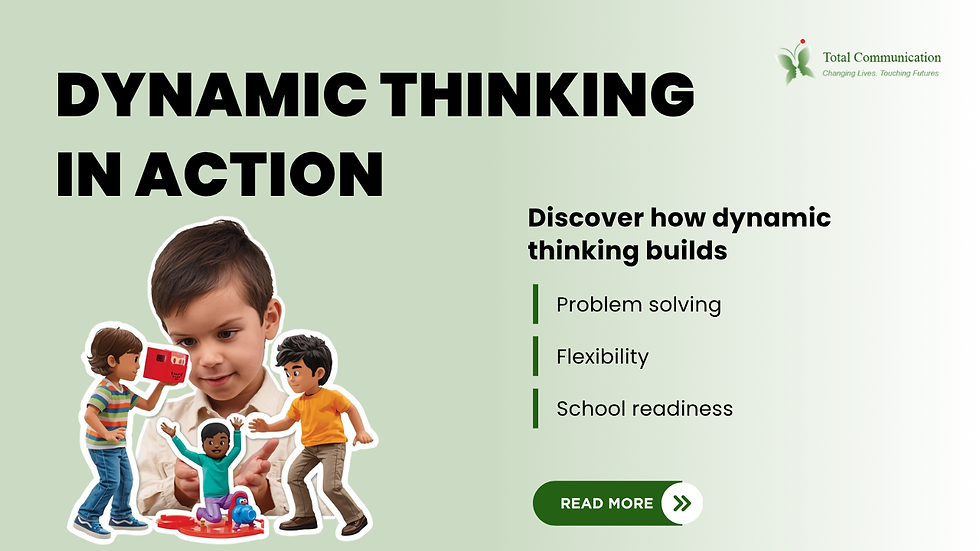
A simple scene unfolds. Yet within this moment, powerful emotional and cognitive processes are at work. This is dynamic thinking in action.
Understanding the Moment: Where Emotion Meets Thought
In this brief interaction, the child identifies an emotional state, assigns meaning, and creates a response. This sequence reflects emotional awareness, perspective-taking, and problem-solving working together.
Dynamic thinking allows the child to move beyond a fixed storyline. Instead of repeating a familiar pattern, the child adapts the play scenario based on an internal understanding of emotion. This flexibility supports emotional development at a foundational level.
Step 1: Emotional Identification Through Symbolic Play
When the child describes the lion as “lonely,” emotional recognition takes place. Play provides a natural context for children to explore feelings. Through symbolic representation, children connect internal experiences with external objects. This process strengthens emotional vocabulary and self-awareness.
Dynamic thinking supports this step by allowing the child to interpret and assign meaning independently, building a deeper understanding of emotions.
Step 2: Perspective-Taking and Social Understanding
The child then considers the lion’s experience and introduces another character to offer companionship.
This reflects perspective-taking. Dynamic thinking enables the child to shift from a single viewpoint to multiple perspectives. This skill forms the foundation of social communication and empathy.
In everyday interactions, this ability supports:
Meaningful peer relationships
Effective communication
Emotional connection
These skills play a critical role in a child’s social and academic development.
Step 3: Problem-Solving Through Flexible Thinking
The child recognises a situation and creates a solution. The storyline evolves from isolation to connection. This reflects cognitive flexibility and problem-solving. Dynamic thinking allows the child to:
Identify a challenge
Generate a response
Adjust the environment
These steps strengthen resilience and emotional regulation. Children learn to approach situations with adaptability and confidence.
Step 4: Language as a Bridge to Emotional Expression
The child expresses the scenario using language: “Now he has a friend.” Language transforms thought into communication.
Through play, children practise:
Structuring sentences
Expressing emotions
Engaging in dialogue
This integration of language and emotion is essential for communication development.
At Total Communication, this connection forms the core of our approach. Through total communication services, we support children in linking thinking, language, and
emotional understanding, allowing them to express ideas with clarity and confidence.
Why This Matters for Parents Now
Moments like these shape how children understand themselves and others. Emotional development begins early and evolves through everyday experiences. When guided intentionally, play becomes a powerful tool for:
Building emotional awareness
Strengthening flexible thinking
Supporting communication skills
Enhancing confidence in social interactions
Children who develop dynamic thinking through play engage more effectively with their environment, respond with greater adaptability, and communicate with clarity.
At Total Communication, our total communication services are designed to nurture these abilities through structured, meaningful play experiences. We focus on strengthening dynamic thinking so children can navigate emotions, interactions, and learning with confidence.
A Closing Reflection
The animals remain on the floor. The lion now sits beside a companion. The story reaches a natural resolution.
In that moment, the child has practised recognising emotions, adapting thinking, and expressing care.
These small experiences carry a lasting impact. Play shapes how children think, feel, and connect. Each interaction builds the foundation for emotional well-being, communication, and resilience. The opportunity to support this development begins now.
A Professional Support
Call/WhatsApp: +65 9115 8895
Fill out the reachout form: https://www.totalcommunication.com.sg/contact
Important Links:


Comments