

Why Children Don’t Learn Best When We “Tell” Them The Power of Guided Participation

Updated: Feb 11
Many children don’t struggle because they can’t learn.
They struggle because learning feels too fast, too big, or too unsafe.
In therapy, we often hear:
“He understands when I explain, but he can’t do it on his own.”
“She shuts down when tasks feel hard.”
“He needs so much support - I’m not sure when to step in or step back.”
This is where Guided Participation becomes so powerful.
Important Links:
What Is Guided Participation?
Guided Participation supports children by turning learning into a shared experience. The adult and child engage together, building understanding through collaboration, modelling, and gentle guidance. Through this co-created process, children develop skills, confidence, and independence naturally, at a pace that feels safe and meaningful.
The adult:
Models.
Scaffolds.
Thinks out loud.
Adjusts support moment by moment.
And gradually, as the child feels safer and more competent, that support fades.
It’s not about pushing independence- it’s about building it from within.
Why Guided Participation Matters in Therapy
Many children we work with have challenges in:
Attention and regulation.
Language processing.
Executive functioning.
Sensory integration.
Anxiety or low confidence.
For these children, being told “Just try harder” doesn’t work. Their brains need:
Clear structure.
Emotional safety.
Predictability.
A partner in the learning process.
Guided Participation provides exactly that.
Learning Feels Safer When You’re Not Alone
When a therapist engages in Guided Participation, the child experiences:
“I’m not being tested.”
“Someone is thinking with me.”
"It’s okay to not know yet.”
This reduces:
Performance anxiety.
Avoidance behaviours.
Shutdown or refusal.
And opens the door for:
Curiosity.
Risk-taking.
Flexible thinking.
What Guided Participation Looks Like in Our Sessions
You might see a therapist:
Sitting with the child, not across from them
Verbalising thought processes (“Hmm… let’s think together”)
Offering just enough help to keep the child moving forward
Slowing down when the child feels overwhelmed
Letting the child lead, while gently shaping the learning
Support is dynamic, not fixed. Some days, a child needs more guidance. Other days, they surprise us with independence. And that’s okay.
From Co-Regulation to Independence
Guided Participation recognises something important: Children cannot be independent if they are dysregulated. Before learning can happen, the nervous system needs to feel safe.
Through guided interaction, children:
Learn how to regulate with support
Internalise problem-solving strategies
Build confidence through shared success
Over time, what was once done together becomes something the child can do alone.
Why This Builds Stronger, More Flexible Thinkers
Because Guided Participation:
Encourages active thinking (not passive compliance)
Builds executive functioning skills like planning, flexibility, and monitoring
Teaches children how to learn, not just what to learn
It supports children in becoming: Thoughtful, Resilient, Curious, and Confident learners.
Learning Is a Relationship
At its heart, Guided Participation is about relationship-based learning.
Children grow best when they feel:
Seen
Supported
Understood
In our therapy sessions, we don’t rush children toward independence. We walk with them- until they’re ready to walk on their own. Because the most meaningful learning doesn’t happen alone, it happens together.
Not sure where to start? Our therapists use Guided Participation across Educational and Speech Therapy to meet your child where they are.
About the Writer:
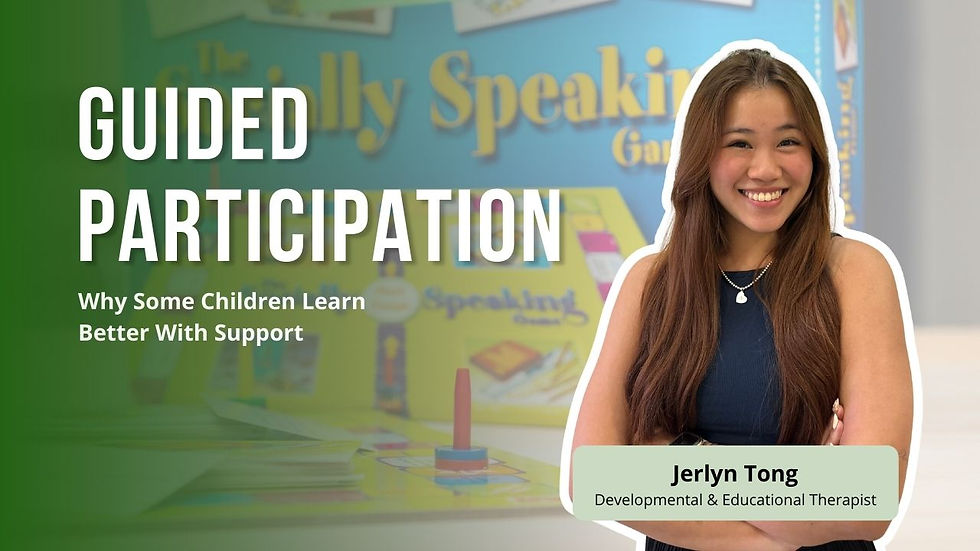
Jerlyn Tong
is a Developmental and Educational Therapist at Total Communication, trained in evidence-based programmes including Lindamood-Bell, the Feuerstein approach, and play-based strategies. With a background in Linguistics and Special Needs Education from NTU, she supports children in building language, thinking skills, and confidence.

Connect with us today to learn more:
Call/Whatsapp: +65 9115 8895
Fill our reachout form: https://www.totalcommunication.com.sg/
Important Links:


Comments