

My Child Knows What They Want, But Gets Frustrated When They Try to Tell Me


KEY TAKEAWAYS
Communication involves far more than knowing words.
A child may understand an idea yet struggle to express it.
Frustration can be a sign of communication difficulty, not simply behaviour.
Gestures, visuals and alternative communication can support expression.
Early support can strengthen communication across home and school.
Total Communication looks at the skills behind the communication breakdown.
The Moment Every Parent Recognises
Your child points towards the kitchen. You offer water. They shake their head.
“Snack?”
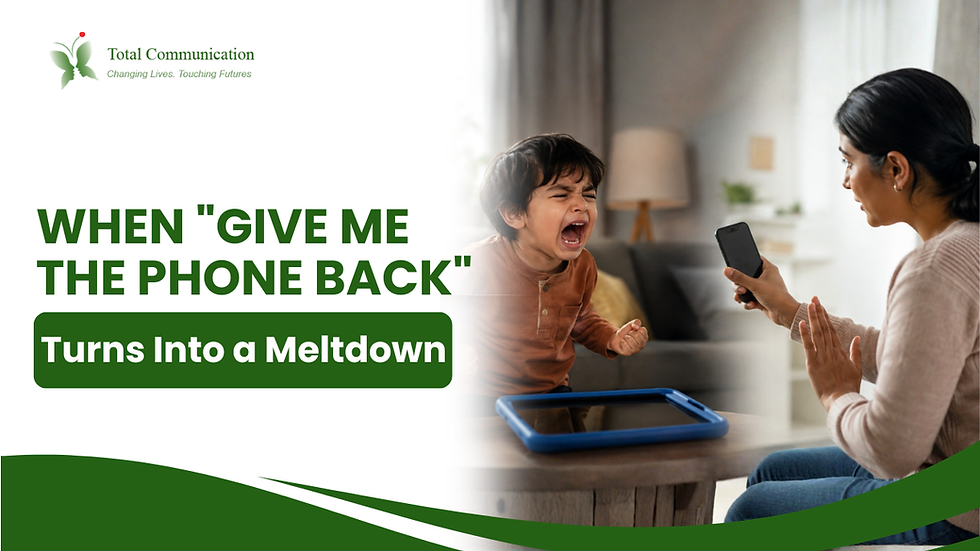
Another frustrated response. You try again. Their voice gets louder, their body becomes tense, and suddenly a simple request has turned into tears. You know they have something specific in mind. They know it too. So why does communicating that thought feel so difficult? That question sits at the heart of many Child Communication Problems Singapore families experience.
The Problem May Be Expression, Not Understanding
A child can have a strong idea in their head while finding it difficult to organise and express that idea. They may understand what you say, recognise familiar routines and know what they want. The challenge appears when they need to:
Find the right word
Put words together
Answer a question
Explain what happened
Tell someone what they need
Make themselves understood clearly
This distinction matters. A child who struggles to communicate effectively may become upset because their message keeps getting lost.
What Could Be Happening?
When a child knows what they want but becomes frustrated while communicating it, the difficulty may involve expressive language, speech production, word retrieval, social communication or planning how to express an idea. Looking at the whole communication process helps identify where the breakdown happens and what support may help.
Why Does Frustration Happen?
Communication requires several skills working together. A child needs to form an idea, choose words, organise them, produce speech and monitor whether the listener understands. For some children, one or more of these steps takes considerably more effort.
Research from the American Speech-Language-Hearing Association highlights that communication difficulties can affect a child's ability to understand, express and use language effectively. Frustration makes sense when a child repeatedly experiences the gap between “I know what I mean” and “I can make you understand me.”
What Should Parents Watch For?
Look at patterns rather than one difficult moment. Signs worth discussing with a professional include:
Frequent frustration during conversations
Heavy reliance on pointing or gestures
Difficulty answering familiar questions
Limited vocabulary growth
Difficulty combining words
Being understood poorly by familiar people
Becoming upset when asked to explain something
Difficulty communicating needs at school or with peers
When Should Parents Seek Support?
Support becomes particularly useful when communication difficulties regularly interfere with everyday life, relationships, learning or participation. A speech-language professional can examine how your child understands language, expresses ideas, produces speech and communicates socially.
When Communication Becomes Easier
Imagine the same kitchen moment. Your child still wants the snack. This time, they have a reliable way to tell you. Maybe they use words. Maybe they combine words with gestures or visual support. Over time, their ability to communicate becomes clearer and their frustration has less work to do.

At Total Communication Therapy in Singapore, communication is viewed within the wider picture of a child's development. Depending on a child's needs, support may involve speech therapy, developmental therapy, educational therapy, the Executive Function Skills Programme, or the Critical Thinking Lab Programme.
The aim is to understand what sits underneath the communication difficulty and build practical skills that help the child participate more confidently at home, in school and socially.
Start With Understanding
You already know your child has something to say. The next step is understanding what is making that message difficult to express. Total Communication Therapy is a specialist speech-language and cognitive development centre in Singapore supporting children aged 3 and above.
Speak with the team at +65 9115 8895 or visit www.totalcommunication.com.sg to discuss what you are noticing.
FAQ
Why does my child get frustrated when they cannot explain something?
Frustration often appears when a child has an idea but struggles to express it clearly. The difficulty may involve vocabulary, sentence formation, speech production or communication planning. Looking at the pattern can reveal which skill needs support.
Can a child understand everything but struggle to speak?
Yes. Understanding language and expressing language are different skills. Some children understand considerably more than they can verbally communicate.
How can I help my child communicate at home?
Give your child extra processing time, model simple language, offer choices and accept gestures or other communication methods. Focus on understanding the message rather than demanding perfect speech.
When should I consider speech therapy in Singapore?
Consider an assessment when communication difficulties repeatedly affect your child's ability to express needs, answer questions, interact with others or participate in everyday activities. An assessment can clarify which communication skills require support.
Can communication difficulties affect learning?
Yes. Communication supports classroom participation, answering questions, explaining ideas, following discussions and interacting with peers. This is why communication development can connect closely with educational and cognitive skills.
Important links:


Comments