

When a Child Starts Stuttering: What It Means and When Parents Should Seek Help

KEY TAKEAWAYS
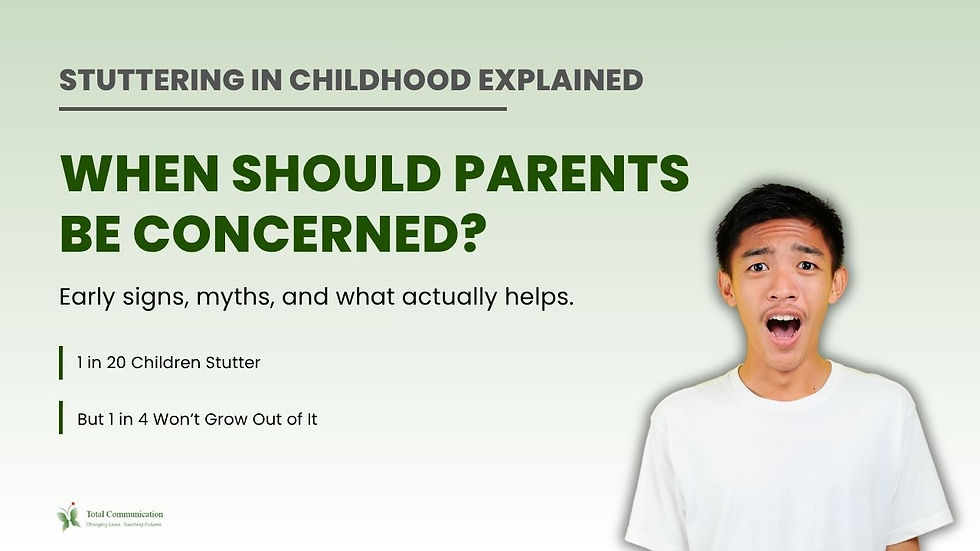
Stuttering affects approximately 1 in 20 children, most commonly between ages 2 and 5.
Some stuttering resolves naturally - but early assessment helps identify which children need support.
Stuttering has neurological roots - it has nothing to do with nerves, shyness, or parenting.
The way adults respond to stuttering significantly shapes a child's confidence and communication.
Speech therapy produces measurable improvements in fluency, confidence, and social communication.
Total Communication Therapy in Singapore provides specialist fluency support for children aged 3 and above.
Ethan is five years old and has more to say than most adults. He loves superheroes, knows the entire plot of every Marvel film, and talks nonstop from the moment he wakes up. But somewhere around his fourth birthday, something shifted. Mid-sentence, the words started getting stuck. "I w-w-w-want to go to the p-p-park." He would stop, look down, try again. Sometimes the word came. Sometimes it did not.
His parents told themselves it was a phase. His preschool teacher called it "normal for his age." But Ethan started talking less. He stopped answering questions in class. He began choosing silence over the risk of getting stuck again.
That shift - from a child who talks freely to one who edits himself before speaking - is one of the most telling signs that stuttering deserves closer attention. So what is actually happening? And when does a phase become something worth addressing?
What is happening when a child stutters?
Stuttering - also called stammering - is a speech fluency disorder characterised by disruptions in the forward flow of speech. These disruptions include repetitions of sounds or syllables ("b-b-ball"), prolongations ("ssssnake"), and blocks where speech stops entirely before a word emerges.
Stuttering is not caused by anxiety, poor parenting, or a traumatic experience. It is neurological in origin. Research using neuroimaging has shown that the brains of people who stutter process speech and language differently - particularly in areas governing motor planning and timing. The child knows exactly what they want to say. The breakdown happens in the split-second process of translating thought into spoken words.
How common is stuttering?
According to the Stuttering Foundation, approximately 5 % of all children go through a period of stuttering - roughly 1 in 20. Of those, around 75 % recover naturally, most before the age of seven. The remaining 25 % - approximately 1 in 80 children - continue to stutter into adulthood without intervention.
This is why early assessment matters. The window between ages two and seven is when natural recovery is most likely - and when targeted speech therapy produces the strongest results for children who need it.
When Does Stuttering Typically Begin?
Stuttering most commonly emerges between ages two and five, during the period of rapid language development. The brain is acquiring vocabulary, grammar, and sentence structure at speed - and for some children, the motor system that produces speech temporarily struggles to keep pace.
Risk factors that suggest a child may benefit from early assessment include:
Stuttering that has persisted for more than six months.
A family history of stuttering.
The child is male - boys are three to four times more likely to stutter persistently than girls.
The child shows visible physical tension - eye blinking, facial grimacing, or struggle behaviours.
The child has started avoiding speaking situations they previously enjoyed.
Quick Answer:
Stuttering is a speech fluency disorder affecting approximately 1 in 20 children, most commonly between ages 2 and 5. It is neurological in origin and characterised by repetitions, prolongations, and blocks in speech. While many children recover naturally, early speech therapy assessment is recommended when stuttering persists beyond six months or causes visible distress.
How Adults Respond Makes a Bigger Difference Than Most Parents Realise
One of the most significant - and least discussed - factors in a child's experience of stuttering is the environment around them. Research consistently shows that a child's emotional relationship with their stutter develops largely in response to how the people around them react.
Finishing a child's sentences, telling them to slow down, or showing visible discomfort when they stutter all teach the child that their speech is a problem to be managed - rather than a communication difference to be understood. Over time, this leads to avoidance, reduced confidence, and in some cases, a deepening of the stutter itself.
The most effective home environment for a child who stutters includes:
Maintaining natural eye contact - without looking away or showing discomfort
Waiting patiently - without finishing sentences or rushing them
Responding to the content of what they said - not how they said it
Modelling a calm, unhurried speaking pace in your own speech
Creating low-pressure speaking opportunities - storytelling, reading aloud together
What Changes When Stuttering Is Properly Supported
The Child Starts Speaking Again
The most immediate and visible change when children receive targeted fluency support is that they begin to re-engage with speaking. The self-editing stops. The avoidance reduces. A child who had gone quiet in the classroom raises their hand again.
Fluency Builds Alongside Confidence
Effective speech therapy for stuttering addresses both the physical mechanics of fluency and the psychological relationship a child has with their own speech. At Total Communication Therapy, sessions focus on building fluency strategies, reducing physical tension, strengthening social communication, and rebuilding the child's confidence as a speaker - in that order. Because a child who feels safe speaking makes faster progress than one who feels monitored.
The Family Finds Its Footing
Parents who understand what stuttering is - and what it is not - stop reacting to it. That shift alone changes the dynamic at home. Mealtimes become easier. Conversations become less loaded. And the child, reading the room as children always do, begins to relax.

At Total Communication Therapy, children who stutter are supported through specialist Speech Therapy that addresses fluency, communication confidence, and social language - alongside Developmental Therapy where executive function and self-regulation skills need strengthening. Every child begins with a thorough individual assessment, because no two children stutter in the same way.
You Have Read This Far Because Something Resonated
That feeling - the one that made you search for this - is worth acting on. At Total Communication Therapy in Singapore, the first conversation is always calm, clear, and without pressure. Total Communication's team of therapists works with children aged 3 to 19 by providing Speech Therapy, Educational Therapy, Developmental Therapy, the Executive Function Skills Programme, and the Critical Thinking Lab.
With close to two decades of experience and partnerships with over 20 local and international schools across Singapore, TCT brings both clinical depth and genuine warmth to every child it works with.
A Professional Support
Call/WhatsApp: +65 9115 8895 Fill out the reachout form: https://www.totalcommunication.com.sg/contact
Frequently Asked Questions About Stuttering in Children
Is stuttering normal for a 3 or 4-year-old?
Some disfluency is entirely typical between ages 2 and 5, as children's language development moves faster than their motor speech system can keep pace with. What distinguishes typical disfluency from stuttering that warrants assessment is persistence beyond six months, physical tension during speech, or a child beginning to avoid speaking situations. When in doubt, an early assessment provides clarity and peace of mind.
Will my child grow out of stuttering on their own?
Approximately 75 % of children who stutter do recover naturally, most before age seven. However, identifying early which children are likely to recover and which may benefit from intervention requires professional assessment. Waiting without assessment means missing the window where therapy is most effective for children who do need support.
Does stuttering mean my child has anxiety?
Stuttering and anxiety are separate conditions — though they frequently interact. Stuttering is neurological in origin and appears in children with no anxiety at all. However, a child who stutters may develop anxiety about speaking over time, particularly if their stutter is met with impatience or discomfort. Speech therapy addresses both the fluency difficulty and the confidence dimension.
How does speech therapy help a child who stutters?
Speech therapy for stuttering uses evidence-based fluency techniques to reduce physical tension, build smoother speech patterns, and strengthen a child's confidence as a communicator. Therapists also work with parents on how to create a supportive speaking environment at home - because what happens between sessions matters as much as what happens within them.
When should I seek a speech therapy assessment for my child's stutter?
Seek an assessment if your child has been stuttering for more than six months, shows physical tension or struggle behaviours during speech, has a family history of stuttering, or has started avoiding speaking situations. Early assessment - ideally before age seven - produces the strongest outcomes and provides parents with a clear, informed picture of what their child needs.
Important Links:


Comments