

What Happens During Therapy for Developmental Language Disorder?

Key Takeaways
Understand what therapy for Developmental Language Disorder looks like.
Learn how therapists personalise sessions to suit each child's needs.
Discover how speech, learning, and thinking skills are developed together.
See how parents play an active role in supporting progress at home.
Explore how Total Communication Therapy in Singapore supports long-term development.
Every Child's Story Starts Somewhere
Your child understands parts of a conversation but struggles to explain what happened at school. They pause while searching for words, miss parts of instructions, or find it difficult to tell a simple story from beginning to end. These moments often leave parents wondering whether their child simply needs more time or whether extra support could make everyday communication easier.
If you've been asking yourself what actually happens during therapy for Developmental Language Disorder, knowing the process often brings reassurance and clarity.
Understanding Therapy Beyond Words
Developmental Language Disorder (DLD) affects a child's ability to understand and use language despite typical hearing, intelligence, and opportunities to learn. Research suggests that around 7% of children are affected by DLD, making it one of the most common developmental conditions in childhood, yet many families remain unfamiliar with it. The encouraging news is that early, structured intervention helps children develop stronger communication, learning, and social skills. Therapy is never about memorising words. It focuses on helping children communicate confidently in real-life situations.
What Happens During Therapy for Developmental Language Disorder?
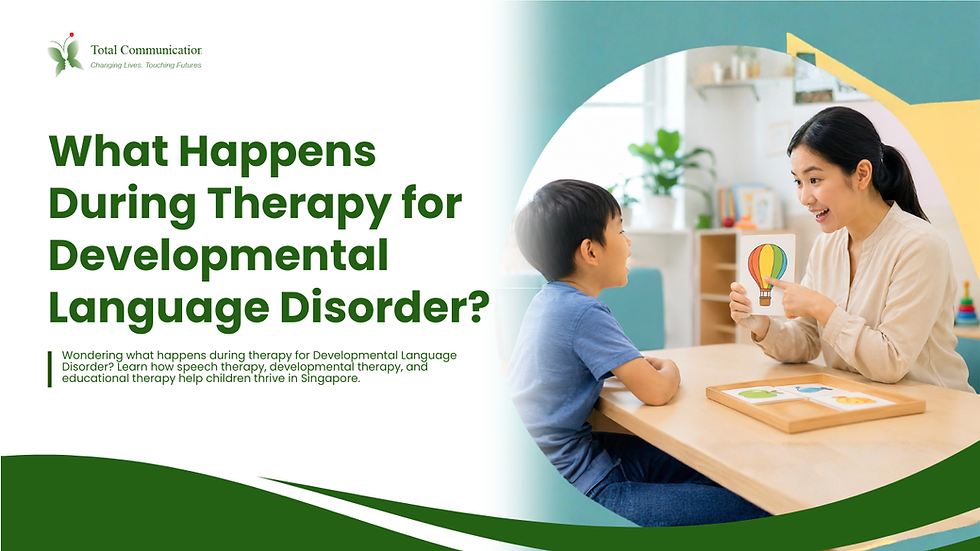
Therapy for Developmental Language Disorder involves personalised sessions that strengthen a child's understanding of language, vocabulary, sentence building, conversation skills, listening, and problem-solving. Therapists use play, structured activities, visual supports, and parent coaching to help children apply communication skills confidently at home, in school, and in everyday life.
Every Therapy Plan Begins with Understanding the Child
Before intervention begins, therapists assess how the child communicates across different situations. This includes observing:
Understanding of spoken language
Vocabulary development
Sentence structure
Storytelling abilities
Social communication
Attention and listening skills
The goal is to identify strengths alongside areas that need support so therapy builds on what the child already does well.
Therapy Looks Like Play With Purpose
Children learn best when they are engaged.
A typical session may include:
Interactive games
Storybooks
Picture sequencing
Role-playing activities
Problem-solving tasks
Conversation practice
Each activity targets specific language goals while keeping children motivated and confident.
Building Skills Beyond Speech
Children with DLD often benefit from support that extends beyond language alone.
At Total Communication Therapy Singapore, intervention may include:
Speech Therapy to strengthen expressive and receptive language.
Developmental Therapy to support attention, play, emotional regulation, and overall development.
Educational Therapy to improve classroom learning and academic participation.
Executive Function Skills Programme to develop planning, organisation, working memory, and flexible thinking.
Critical Thinking Lab Programme to strengthen reasoning, problem-solving, and higher-level language skills.
This integrated approach helps children use communication more effectively across school, friendships, and daily routines.
Parents Become Part of the Therapy Team
Progress happens most consistently when therapy continues outside the clinic.
Parents receive practical strategies that fit naturally into everyday routines, including:
Expanding conversations during meals
Asking open-ended questions while reading
Encouraging storytelling
Following multi-step instructions during play
Building vocabulary through daily experiences
Small moments repeated consistently often create meaningful long-term growth.
Research published by the American Speech-Language-Hearing Association (ASHA) and long-term studies on Developmental Language Disorder consistently show that early intervention and active family involvement improve communication, academic participation, and social outcomes.
Small Changes Lead to Bigger Confidence
Children rarely change overnight. Instead, parents begin noticing small but meaningful milestones:
Longer conversations
Better understanding of instructions
Increased classroom participation
Greater confidence speaking with friends
Improved learning and problem-solving
Less frustration during everyday communication
At Total Communication Therapy, every programme is designed around the child's individual strengths while supporting communication, learning, and thinking together. This coordinated approach helps children build skills that continue growing long after each therapy session ends.
Take the Next Step with Total Communication Therapy
Understanding what happens during therapy for Developmental Language Disorder often brings relief because the process is structured, evidence-based, and focused on helping children succeed in everyday life. If your child finds communication, learning, or following conversations more challenging than expected, speaking with experienced therapists provides clarity and a personalised plan for moving forward.
The team at Total Communication Therapy, Singapore offers Speech Therapy, Developmental Therapy, Educational Therapy, Executive Function Skills Programme, and Critical Thinking Lab Programme to support every stage of your child's development.
Book a consultation today:
📞 +65 9115 8895
🌐 www.totalcommunication.com.sg
Frequently Asked Questions (FAQs)
What is Developmental Language Disorder (DLD)?
Developmental Language Disorder (DLD) is a neurodevelopmental condition that affects a child's ability to understand and use spoken language. Children with DLD may have difficulty following instructions, learning new vocabulary, forming sentences, or expressing their thoughts clearly. These challenges occur without another primary condition explaining the language difficulties and can affect learning, friendships, and everyday communication.
What happens during therapy for Developmental Language Disorder?
Therapy for Developmental Language Disorder is personalised to each child's strengths and needs. Sessions often include play-based activities, storytelling, vocabulary building, sentence practice, listening exercises, conversation skills, and problem-solving tasks. Therapists also guide parents with practical strategies so children can practise new communication skills during everyday routines at home.
How often should my child attend therapy for Developmental Language Disorder?
The recommended frequency depends on your child's age, goals, and level of support needed. Many children attend therapy once or twice a week, while therapists regularly review progress and adjust the programme as communication skills develop. Consistent attendance, combined with practice at home, often supports steady progress.
Can Developmental Language Disorder improve with therapy?
Yes. Early, evidence-based intervention helps many children make meaningful progress in understanding language, expressing themselves, and participating confidently at home and in school. While every child's pace is unique, therapy provides the tools and strategies needed to strengthen communication and learning over time.
Does my child only need speech therapy for Developmental Language Disorder?
Some children benefit from speech therapy alone, while others achieve better outcomes through a multidisciplinary approach. Depending on your child's needs, support may also include Developmental Therapy, Educational Therapy, the Executive Function Skills Programme, and the Critical Thinking Lab Programme. These services work together to strengthen language, learning, attention, organisation, and problem-solving skills.
When should I seek professional help if I suspect Developmental Language Disorder?
If your child regularly struggles to understand instructions, express ideas, tell stories, answer questions, or keep up with classroom communication compared with peers, it is a good time to seek a professional assessment. Early identification allows therapists to provide targeted support before language challenges begin affecting academic progress, confidence, and social relationships.


Comments