

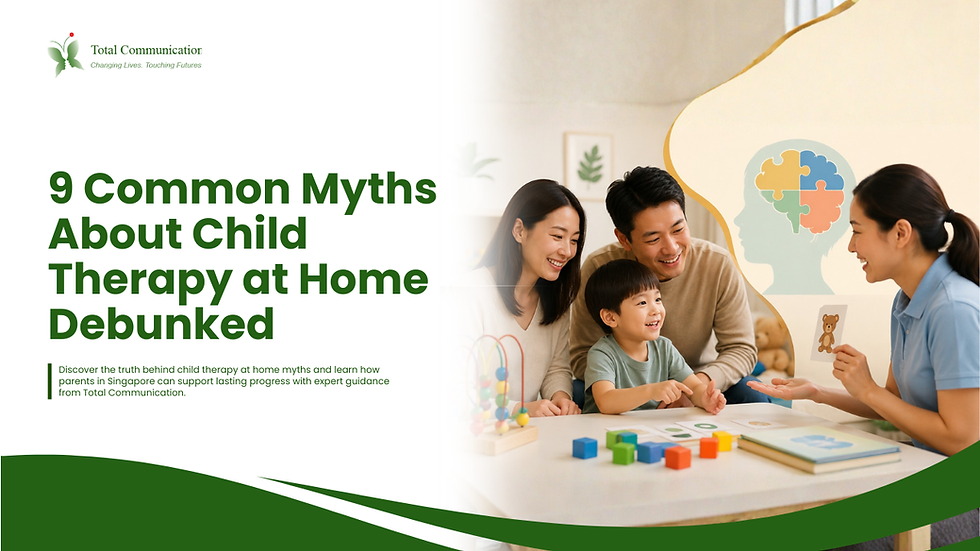
9 Common Myths About Child Therapy at Home Debunked

Updated: Jul 7
Key Takeaways
Understand the biggest misconceptions about child therapy at home.
Learn what parents can realistically achieve through daily support.
Discover why professional guidance creates better long-term outcomes.
Explore how speech, developmental, educational, and executive function programmes complement home practice.
Know when additional support helps children build confidence and independence.
Every evening, Mia's parents set aside twenty minutes to practise communication games they found online. Some days she happily joins in. Other days she loses interest after just a few minutes. Her parents begin asking themselves the same question many families quietly wonder.
"Are we doing enough at home?"
Parents naturally want to give their children every opportunity to thrive. The internet offers endless advice, family members share different opinions, and social media is filled with success stories. Somewhere between all that information, myths about child therapy at home often become accepted as facts. The good news? Home support plays an incredibly valuable role. The even better news? Understanding what truly helps children grow makes every effort more meaningful.
Why So Many Myths Exist About Child Therapy at Home
Parents spend more time with their children than anyone else, making home the perfect place for learning opportunities. Because of this, many people believe home activities alone provide everything a child needs. In reality, children's communication, learning, thinking, and emotional development involve many interconnected skills. Home practice becomes most effective when it follows evidence-based strategies developed by trained professionals.
Rather than choosing between home support and therapy, families often achieve the strongest outcomes by combining both.
Child therapy at home works best when parents reinforce strategies introduced by qualified therapists. Home activities strengthen learning through daily practice, while professional assessment and intervention identify underlying developmental needs, personalise goals, and adjust therapy as children grow. Together, they create the strongest foundation for long-term progress.
Myth 1: Parents Can Replace Professional Therapy
Parents are their child's greatest advocates and everyday teachers.

Therapists bring specialised knowledge in child development, assessment, communication science, learning, cognition, and behaviour. Professional guidance helps identify why a child faces certain challenges rather than simply focusing on the visible behaviours.
At Total Communication Therapy Singapore, therapists work alongside families, turning parents into confident partners throughout the process.
Myth 2: Child Therapy at Home Means Buying Educational Toys
Expensive toys rarely determine progress.
Children often learn best through everyday routines like:
Preparing breakfast
Reading bedtime stories
Grocery shopping
Building with household objects
Playing simple turn-taking games
Meaningful interaction consistently delivers greater developmental value than expensive equipment.
Myth 3: Progress Should Be Visible Within Days
Every child develops at their own pace. Speech, language, executive functioning, attention, emotional regulation, and cognitive flexibility develop gradually through repeated practice.
Research from organisations including the American Speech-Language-Hearing Association consistently shows that early intervention combined with regular family involvement supports stronger long-term communication outcomes. Consistency often matters more than speed.
Myth 4: Therapy Is Only for Children With Severe Difficulties
Many children benefit from support before challenges become more noticeable.
Some children may need help with:
Expressing ideas clearly
Following instructions
Social communication
Learning readiness
Organisation
Emotional regulation
Problem-solving
Early support often helps children build confidence before everyday struggles become more significant.
Myth 5: Online Advice Works for Every Child
Parents today have access to thousands of videos and activity ideas.
The challenge is that every child's strengths, needs, personality, learning style, and developmental profile are different. Activities that help one child may not address another child's specific goals. Professional assessment allows therapy plans to match each child's individual needs.
Myth 6: Speech Therapy Only Focuses on Talking
Many people associate speech therapy with pronunciation alone.
Modern speech and language therapy also supports:
Understanding language
Social interaction
Conversation skills
Listening
Vocabulary development
Literacy foundations
Confidence in communication
Communication influences learning, friendships, and everyday independence.
Myth 7: Home Practice Needs Hours Every Day
Quality matters far more than quantity. Five to fifteen minutes of purposeful activities throughout the day often create stronger learning opportunities than one long session.
Examples include:
Asking open-ended questions during meals
Encouraging storytelling
Taking turns during games
Following multi-step instructions during daily routines
These moments naturally reinforce therapeutic goals.
Myth 8: Academic Skills Matter More Than Thinking Skills
Reading and mathematics remain important, yet children also need strong thinking abilities.
Programmes that strengthen:
Executive function skills
Critical thinking
Working memory
Flexible thinking
Planning
Self-regulation
help children become more independent learners.
This is why many families at Total Communication benefit from services beyond speech therapy, including Developmental Therapy, Educational Therapy, the Executive Function Skills Programme, and the Critical Thinking Lab Programme, depending on each child's needs.
Myth 9: Starting Later Makes No Difference

One of the biggest misconceptions is believing children will naturally outgrow every developmental challenge. Many children continue making excellent progress at different ages. At the same time, research consistently highlights that earlier intervention provides more opportunities to strengthen developing brain pathways while children are still building foundational communication and learning skills. The earlier families understand their child's needs, the sooner meaningful support can begin.
Why Professional Guidance Makes Home Practice More Effective
The strongest outcomes often happen when therapy extends beyond the clinic.
At Total Communication Therapy, families receive practical strategies that naturally fit into everyday life.
These may include:
Communication routines
Home language activities
Learning strategies
Executive functioning exercises
Parent coaching
Progress monitoring
Instead of guessing what might help, parents gain clear direction backed by professional expertise.
What Changes When Myths Are Replaced With Knowledge?
Parents often notice positive changes that extend well beyond therapy sessions.
Children may begin to:
Express themselves more confidently.
Follow routines with greater independence.
Participate more actively in school.
Build stronger friendships.
Solve problems with growing confidence.
Feel proud of their achievements.
Families also experience greater confidence because they understand how to support progress every day.
At Total Communication, every programme is designed around the individual child. Depending on their needs, therapists may recommend Speech Therapy, Developmental Therapy, Educational Therapy, Parent Training, the Executive Function Skills Programme, or the Critical Thinking Lab Programme. Together, these services help children build communication, learning, and life skills that continue growing beyond the therapy room.
An Invite to connect
Every child develops differently, and every family deserves guidance they can trust.
If you've been wondering whether your home strategies are supporting your child in the best possible way, a conversation with the team at Total Communication Therapy Singapore offers clarity, practical advice, and a personalised direction forward.
Book a consultation today.
📞 WhatsApp: +65 9115 8895
🌐 Website: www.totalcommunication.com.sg
Frequently Asked Questions
Does child therapy at home really work?
Yes. Child therapy at home becomes highly effective when parents reinforce strategies introduced by qualified therapists. Daily practice strengthens new skills, while professional guidance ensures activities match the child's developmental needs.
When should I seek professional therapy instead of only practising at home?
If your child continues experiencing challenges with communication, learning, attention, social interaction, or emotional regulation despite consistent support, an assessment provides valuable insight. Early guidance often makes home practice more focused and effective.
How much home practice should parents do every day?
Many therapists recommend short, meaningful activities integrated into daily routines. Around five to fifteen minutes several times throughout the day often creates better engagement than longer structured sessions.
Can speech therapy and developmental therapy happen together?
Yes. Many children benefit from a combination of services. Depending on individual goals, therapists may recommend Speech Therapy, Developmental Therapy, Educational Therapy, Executive Function Skills Programme, or Critical Thinking Lab Programme to support different aspects of development.
How do I know which programme is right for my child?
A professional assessment provides the clearest starting point. Therapists observe your child's strengths, developmental profile, learning style, and everyday challenges before recommending the most appropriate support plan.


Comments